
South Africa raises threshold for distributed generation to 100 MW
The new provisions were published in the country’s official journal on Friday and are now in force. Large scale PV plants of up to 100 MW may be built without requesting a license, through a simplified procedure with the national regulator.

Brazil imported 4.88 GW of PV modules in H1
According to a new report from Brazilian consultancy Greener, the Latin American country installed 1,450 MW of distributed generation PV systems and just 63 MW of large-scale PV plants in the first half of 2021. Despite the disappointing large-scale performance, the strength of the distributed segment should ensure another record year for the Brazilian solar sector.
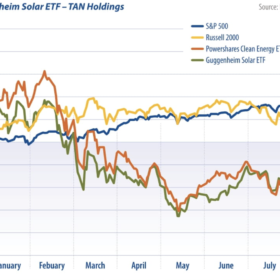
Guggenheim Solar Index: Solar’s shipment struggle
The outlook for U.S. residential solar remains strong, according to Jesse Pichel of ROTH Capital Partners. The large-scale segment, however, is hampered by rising costs and the likelihood of sanctions on Xinjiang-made materials.

The Chinese PV Industry Brief: Tongwei raises solar cell prices
Canadian Solar also reports solid Q2 results, with PV shipments reaching 3.7 GW and revenue totaling US$1.43 billion.

India hits 100 GW renewables milestone
Solar’s share in the installed 100 GW renewable energy capacity stands at around 44%, and wind at 40% as per the data available from India’s Central Electricity Authority.
Blue is not the new green
A new study from Stanford University and Cornell University shows that blue hydrogen can produce more greenhouse emissions than heat produced by coal and gas. The modeling classifies blue hydrogen emissions as carbon dioxide and unburned fugitive methane, as well as lifecycle emissions linked to the mining, transport, storage, and use of methane.

SMA warns of electronic component shortage
In the first half of the year, the German PV inverter maker recorded high demand for its inverters and storage solutions from the residential solar segment. The effects of the corona pandemic, however, have had an impact on the commercial segment and, although a recovery in demand is expected in the second half of the year, SMA said it is currently dealing with delivery issues.

Canadian Solar posts solid Q2 results, lowers 2021 shipment guidance
The solar PV module manufacturer reported strong growth for its energy storage business and an overall 105% year-on-year turnover growth. Its total module production capacity reached 19.7 GW at the end of June.

Germany needs 446 GW of PV for 100% renewables scenario
According to a new study by the Fraunhofer ISE, there is more than enough space for this huge growth in installed solar PV capacity. Indeed, if all available areas were used for PV – including opencast mines, facades, roads, and agricultural land used in combination with solar power generation – over 3,000 GW could be deployed.

Poland deployed 1.3 GW of solar in H1
In the second quarter of the year, more than 763 MW of solar was deployed in the eastern European country.
