
Solar inverters can detect cyberattacks but no one sees the signal
A King Abdullah University of Science and Technology (KAUST) researcher whose lab has demonstrated up to 100% accuracy using a single hardware counter tells pv magazine that firmware-level detection of inverter attacks is technically viable – but today’s communication standards do not transmit the firmware‑integrity signal to operators.

Chinese PV Industry Brief: Longi, Trina Solar report losses
Longi says its 2025 revenue and losses declined year on year, while Trina Solar reports deeper full-year losses and margin pressure across its core module business.

People, purpose and systems thinking: The leadership layer of the energy transition
Women in Solar+ Europe highlights this week the insights shared by industry leaders during the panel “Impact Leadership in Solar & Storage: securing the energy transition through people, purpose and systems thinking,” organised by the leadership ecosystem Solar+ Leaders at Solar & Storage Live London. Bringing together voices from across the value chain, the discussion explored how leadership is evolving in response to growing system complexity, skills gaps, and the need for greater alignment across the industry.

Montenegro developer signs grid deal for 385 MW solar plant
M Energy d.o.o. has signed a grid-connection agreement with Montenegro’s transmission operator for a 385 MW solar project, which would be the largest in a country with around 30 MW of installed PV capacity.
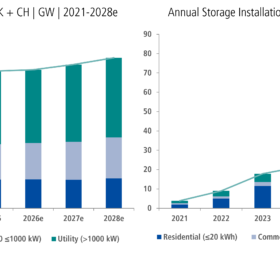
Europe’s solar and storage development: Selectivity amid rising global supply and returning energy shocks
Escalating Middle East tensions and global energy supply risks are accelerating Europe’s shift toward solar and storage, particularly in commercial, industrial, and utility-scale segments where energy security, resilience, and price stability are becoming central investment drivers. At the same time, expanding manufacturing capacity in China and India is redirecting surplus solar and storage supply toward Europe, creating a highly competitive and increasingly selective market where long-term success depends on quality, reliability, ESG alignment, and strategic market positioning.

California sets precedent by overriding local blockade for massive solar-plus-storage project
California is asserting state authority to revive the $700 million Soda Mountain project, marking a new era where Sacramento can reclaim authority from local counties to force stalled utility-scale solar and storage across the finish line.

Mozambique relaunches 30 MW solar tender in EU-backed program
Mozambique’s energy regulator has reopened pre-qualification for a 30 MW solar project in Sofala province, after a previous award to Total Eren under the same program in 2022.

EU hydrogen mechanism connecting supply and demand activates hundreds of projects
The first operational round of the EU Hydrogen Facility matched 265 supply-side opportunities with 45 demand projects, with 87% of offers receiving at least one expression of interest and half attracting multiple buyers.

Singapore requires hydrogen-ready gas capacity in 2031 generation tender
Singapore’s Energy Market Authority (EMA) has made hydrogen readiness a mandatory requirement in a new request for proposals for at least 600 MW of gas-fired generation capacity, with proposals that do not meet cardinal requirements disqualified from evaluation.
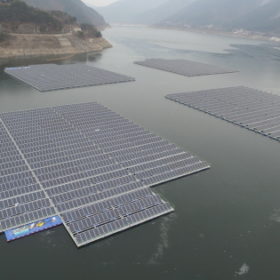
South Korea plans 3 GW of reservoir floating solar by 2030
Korea Rural Community Corp. (KRC) says it plans to increase floating solar capacity on agricultural reservoirs to 3 GW by 2030, from 105 MW currently in operation.
