IEA versus the reality of solar PV
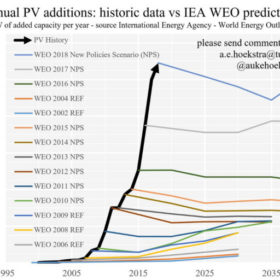
In the recently released World Energy Outlook, the International Energy Agency (IEA) foresees a steady decline in the global expansion of PV to 2035. In response, Dutch researcher Auke Hoekstra has updated his graphic, IEA versus reality in solar PV.

SolarPower Europe appoints new CEO
Walburga Hemetsberger has led the EU Representation Office of Austrian energy company Verbund AG for the past 10 years. At the same time, she was also a board member of Hydrogen Europe, in charge of Energy Transition Solutions.
Centrica to join London blockchain trial for alternative billing
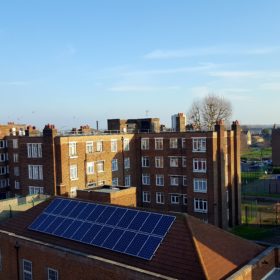
Using a blockchain-based energy trading system, the company seeks to examine ways to bill customers in the best manner for them and prosumers. In light of the potential removal of export tariffs for small scale solar in the UK, the system could provide alternative remuneration for system owners. The trial will run for six months, with the possibility of extending it to two years.
European Court of Justice censors European Commission approval of UK capacity market
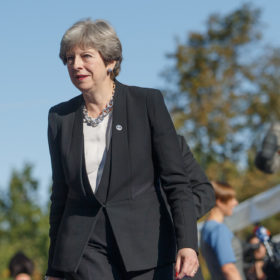
With Theresa May’s government in full scale revolt this week over Brexit, the ECJ’s ruling that the European Commission wrongly failed to find fault with the UK capacity market mechanism four years ago, is likely to have Brexiteers on both sides of parliament frothing at the mouth with indignation.
UK Government: ‘The devil is in the details’ for allowing RE in Capacity Market
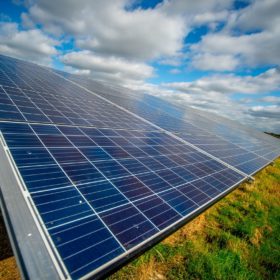
A conference held this week in London shed light on the U.K. Government’s timeline for reviewing its Capacity Market and Contracts for Difference schemes, and what the changes could mean for renewable – and specifically solar PV – energy projects.

Argentina launches 400 MW mini renewables auction
Some 350 MW will be divided between wind and solar for projects of 500 kW to 10 MW in scale. The ceiling price for solar and wind has been set at $60/MWh.
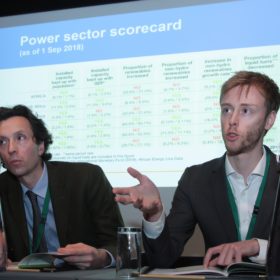
African Energy Data Book launched
Africa Energy, a U.K. based consultancy has launched the African Energy Data Book, which it claims is the first attempt to track the continent’s electricity capacity in a single volume. PV Magazine attended the unveiling of the book.
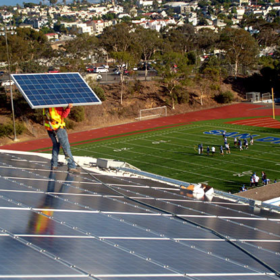
US energy firm AES commits to 70% carbon reduction in climate scenario report
The utility giant is preparing for a greener future with plans to cut carbon emissions, while integrating increasing levels of renewable generation and energy storage.

Canada’s Alberta raises budget for solar rebates
The Canadian province will provide an additional CA$7.5 million for projects run by municipalities, while offering more advantageous conditions for businesses and non-profits.
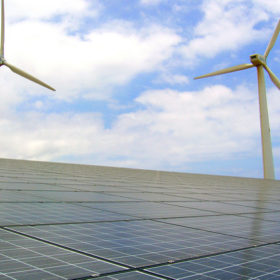
Spain wants 100% renewable electricity by 2050 as part of climate change strategy
The Law on Climatic Change being prepared by the Spanish government provides greenhouse gas emissions be reduced by 20% compared to 1990 levels in 2030, and that the electric system has 70% generation from renewable energy sources. By 2050, the targets will be raised to 90% and 100%, respectively.
