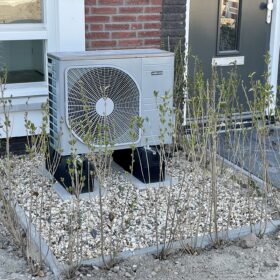
Dutch scientists assess consumers’ willingness to pay for renewable heating
A survey of 1,797 residents was used to determine the willingness to pay for low-carbon residential heating in the Netherlands. On average, respondents were willing to pay a premium of 33% for electricity-based heating. Policy recommendations were also provided as part of the study.

Australia’s largest transmission project reaches major milestones
Australia’s EnergyConnect project – a 900 km transmission line that will link the energy grids in the states of South Australia, Victoria, and New South Wales – has hit two major milestones, including progress on the main substation hub.

Novel blockchain-based virtual utility for P2P PV trading
Researchers from Canada’s Western University have developed an open-source, blockchain-based virtual utility for peer-to-peer (P2P) solar trading, using smart contracts to save up to $1,600 (US dollars) for 10 homes in simulated scenarios.

EDF Renewables wins tender for largest PV plant in Israel
EDF Renewables says it has won a tender to build and operate Israel’s largest PV plant, a 300 MW project near Dimona, with a bid under $0.019/kWh – the lowest price ever in the Israeli market.

Atess Power releases 100 kW/150 kW commercial inverters
Atess Power says it has developed 100 kW/150 kW commercial inverters with two maximum power point trackers (MPPTs), a 600 V to 900 V battery voltage range, and 10 milliseconds on/off grid transfer capability.

Sineng Electric turns on 150 MW/300 MWh of storage in China
Sineng Electric has switched on a 150 MW/300 MWh standalone energy storage station in Guangxi, China, featuring battery energy storage system (BESS) containers, a central power conversion system (PCS), and a booster station.
PV module cooling tech based on single-channel containing nanofluids
Scientists in Mexico have conceived a new solar module cooling tech that can reportedly improve PV power generation by up to 2%. The system uses nanofluids embedded in an aluminum single-channel attached to the back of the panel.

PV systems can now support grid as fossil fuels decline, says IEA-PVPS
A new report by the International Energy Agency’s Photovoltaics Power Systems Programme (IEA-PVPS) says that existing PV systems have the technical capabilities to provide various frequency-related grid services.

Scientists classify weather types based on extreme photovoltaic output events
Scientists used a year’s worth of data from East China to analyze what weather conditions affect abnormal, high, and low PV output days. They also constructed a simple extreme output prediction model and examined the atmospheric circulation anomalies corresponding to extreme output events.

Israel presents 2050 net-zero roadmap envisaging up to 77% solar share
The Israeli Ministry of Energy and Infrastructure has presented three scenarios for its 2050 green goals, changing in accordance with developments in solar, hydrogen, and nuclear power production. In the most solar-focused scenario, the country would have a PV capacity of 108 GW.
