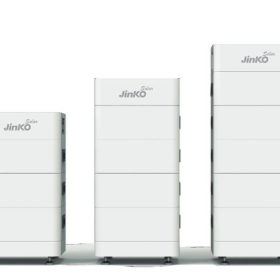
Storage could reshape solar market in MENA
Waleed AlHallaj, the head of business development for the Middle East and North Africa (MENA) at JinkoSolar, recently spoke to pv magazine about the prospects for the regional energy storage market. He said that storage systems have already penetrated markets with weak grids, such as Yemen and Lebanon.

Fraunhofer ISE develops direct metallization tech for heterojunction solar cells
Germany’s Fraunhofer ISE is applying its FlexTrail-printing technology to the direct metallization of silicon heterojunction solar cells. It said the technique reduces the use of silver, while maintaining high efficiency levels.
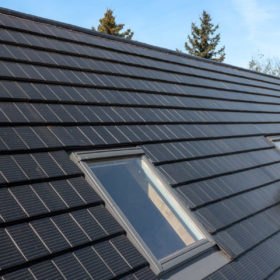
New solar tiles from Germany
Creaton and Autarq have developed a modular solar tile for complex rooftops. The product is reportedly compatible with all common PV inverters.
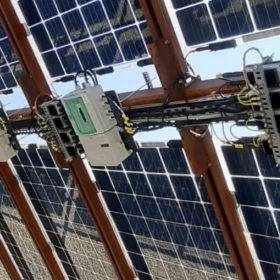
Enel Green Power, INES develop DC/DC MPPT converter for solar panels
Enel Green Power’s initial tests show that the addition of DC/DC MPPT converters to a pilot PV plant has driven a 1% energy production gain. It now plans to deploy the solution on a 1 MW power plant in Italy.
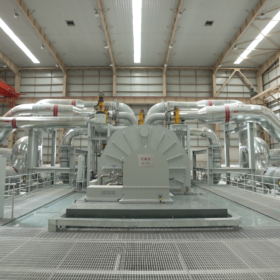
World’s largest compressed air energy storage project goes online in China
The Chinese Academy of Sciences has switched on a 100 MW compressed air energy storage system in China’s Hebei province. The facility can store more than 132 million kWh of electricity per year.
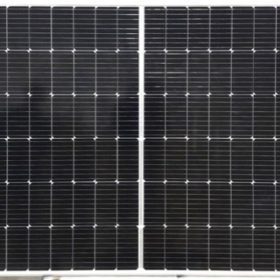
NeoSol unveils 550 W mono PERC solar modules
Indian solar manufacturer NeoSol has unveiled its Black Pearls series of mono PERC modules. The power outputs range from 535 W to 550 W, with power conversion efficiency ratings between 20.7% and 21.33%.
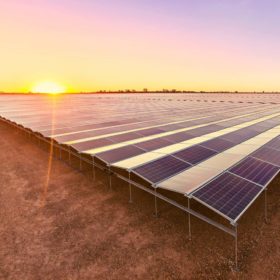
Australia’s first solar-powered cryptocurrency-mining center to combat curtailment
The operators of an energy-intensive, cryptocurrency-mining facility in Whyalla, Australia, believe they can offer a solution to the curtailment issues that haunt many developers of solar projects in the National Electricity Market.
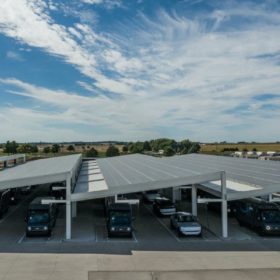
US electric truck company activates solar canopy charging yard
Rivian’s electric trucks will receive their first charge at the company’s US factory, from renewable energy produced by a 783 kW solar parking canopy.
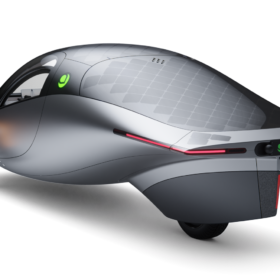
Aptera’s solar car to use Maxeon PV cells
Aptera’s solar electric vehicle, equipped with almost 700 W of PV cells, can drive up to 40 miles (64 km) on solar alone, or 1,000 miles on batteries.
Perovskite solar cell with copper electrode hits 20.1% efficiency
Chinese researchers have developed a new solar cell with a planar n-i-p structure and an indium tin oxide (ITO) substrate. It also has a tin(IV) oxide (SnO2) buffer layer, a perovskite layer, a hole transport layer (HTL), and a layer made of copper. It was able to retain around 92% of its initial efficiency after 1,000 hours.
