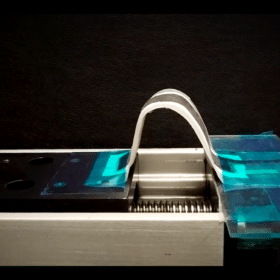
A silver-oxide zinc battery — flexible, screen-printed and with 20 times the capacity of Li-ion
A team comprising researchers from the University of California San Diego and micro battery developer ZPower have developed been busy in the lab. The result is a flexible battery with highly competitive electrochemical features and the option to manufacture at low cost with screen-printing.
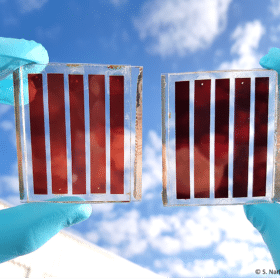
Semi-transparent dye-sensitized solar module with 8.7% efficiency
The mini-panel showed a short circuit current of 58.1 mA, an open circuit voltage of 3.63 V, and a fill factor of 58.26%. It has a power output is 122.9 mW and an active area of 14 cm2.

New safety standard for PV hazard control
The American National Standards Institute (ANSI) and the Standards Council of Canada (SCC) have approved the new UL 3741 standard.
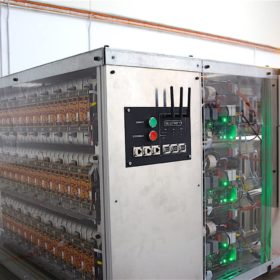
Relectrify posts results from second-life battery systems
After more than a year of testing, Relectrify has released the interim results of a pilot that combines repurposed batteries from Nissan Leaf vehicles with proprietary inverter technology.
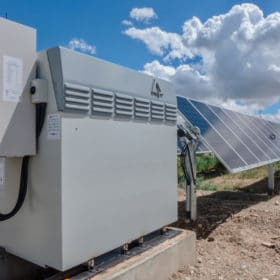
Australian PV plant tests 2 MW/8 MWh vanadium flow battery
Australia’s first utility-scale vanadium flow battery will be built in South Australia. It will demonstrate the tech’s potential to provide energy and frequency control ancillary services for the national grid.
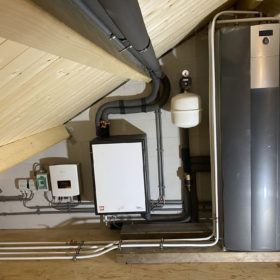
Photovoltaic-thermal district heating networks are feasible
A group of scientists and companies in the Netherlands has tested a PVT heating concept in a green district and has found that the proposed design, which is also based on underground storage and the use of heat pumps, is technically and economically feasible.

A closer look at perovskite degradation
Scientists in Japan put perovskite solar cells under the microscope, aiming to observe at the molecular level the degradation mechanisms that can occur during operation. Their findings offer an improved understanding of performance loss in perovskite thin films, as well as several pathways towards mitigation.
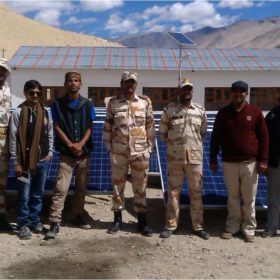
Solar power providing heat for Indo-Tibetan border outposts
Indo-Tibetan Border Police outposts along India’s border with China are using MicroSun solar panels to generate electricity for heating purposes, among other applications.
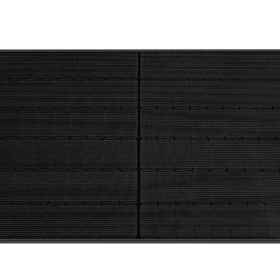
Panasonic launches module series compatible with its Evervolt battery
Available in four different products, the series features a conversion efficiency of 20-21.2%. Two of the panels are packaged in a sleek, all-black aesthetic.

Offshore floating PV may reach maturity in 2030
According to a report from DNV GL, the North Sea may host around 100 MW of floating solar capacity by 2030, and 500 MW by 2035. The LCOE of offshore PV systems is currently estimated at around €354/MWh but in the future it should be close to that of ground-mounted solar parks.
