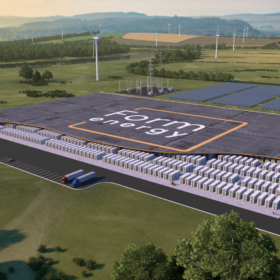
Small 24/7 clean power commitments could cut costs for long-duration storage
TU Berlin researchers say early demand for round-the-clock carbon-free electricity could help bring advanced energy technologies to market faster through technology learning effects. Grant funding for the research was provided by Google, which has since announced plans to build the world’s largest iron-air battery.

Thermocold debuts air-to-water heat pump for commercial buildings
The new product line covers 124–644 kW in heating and 128–632 kW in cooling, operates down to -15 C, and supports various configurations with R454B or R410a refrigerants.

Hinen releases residential off-grid inverter
The 3 kW N3300S inverter combines a pure sine wave inverter with an integrated MPPT solar charge controller for small residential and hybrid PV systems. The unit supports multiple power sources, flexible battery chemistries, and rapid grid/off-grid switching.
Growing pains: Grid congestion as a renewables bottleneck
The electricity grid is a real bottleneck for energy in the United States, and it’s not only utilities and grid operators who are struggling. Grid congestion also puts pressure on renewable energy project owners and is as much a business problem as it is a technical one, writes Alon Mashkovich, CEO of energy management business software supplier enSights.
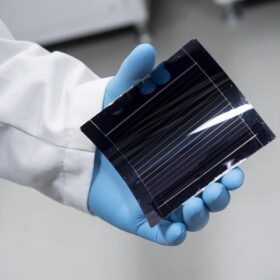
Why CIGS solar keeps lagging behind crystalline silicon
In an interview with pv magazine, Empa scientist Mirjana Dimitrievska explains that the CIGS photovoltaic technology, while promising for efficiency and flexible applications, faces persistent challenges in scaling lab-level performance to cost-effective, high-throughput industrial production, limiting its ability to compete with crystalline silicon. She also emphasizes that long-term stability, reliability, and material sustainability, rather than peak efficiency, are crucial for commercial viability, especially in niche markets like building-integrated and lightweight PV.
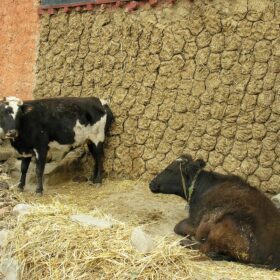
Photovoltaics for cattle dung gasification
Researchers tested a solar PV-powered system to gasify dried cattle dung, achieving higher energy recovery than grid-powered setups.Their techno-economic-environmental analysis shows the approach can cut emissions and be economically viable, though system utilization and operational factors strongly affect profitability.
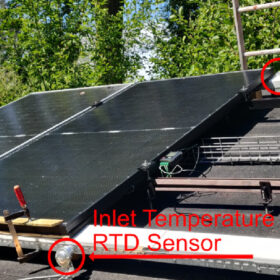
Air-based photovoltaic-thermal system can achieve significant energy savings in buildings
Researchers in Sweden have developed an air-based photovoltaic-thermal system that can preheat ventilation air and domestic hot water, cutting district heating demand by up to 16% for ventilation and 7% for hot water while also reducing peak heating loads in cold Nordic climates.
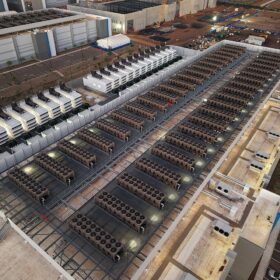
The limits to growth: The Malaysian way of navigating the data centre boom
Malaysia’s rising power demand, driven by industrial growth and data centers, is exposing grid and capacity constraints, prompting policies like Corporate Renewable Energy Supply Scheme (CRESS) to enable corporate renewable procurement while maintaining system cost recovery. A key factor is the System Access Charge (SAC), whose uncertain future trajectory affects long-term solar PPAs and investment decisions, making scenario-based modelling crucial for assessing project bankability.
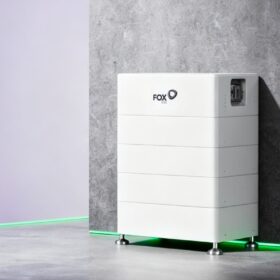
Energy Storage Inspection 2026: Fox ESS, SMA, SAX Power, Kostal and BYD impress with high efficiency
Twelve photovoltaic storage systems with capacities of 5 kW or 10 kW were included in the comparison, among them several new products, all of which achieved efficiency class A. A new study – also examining efficiency losses when storing electricity from the grid – highlights the importance of highly efficient battery storage. The researchers also took a closer look at the warranty conditions of the devices.

Chinese PV Industry Brief: Longi tops 800 MW Hexi solar module tender
Longi says it has ranked first in a recent 800 MW PV module tender in China’s Gansu province, while Canadian Solar says the first 2 GW phase of its US heterojunction (HJT) cell factory is set to begin pilot production in March or April.
