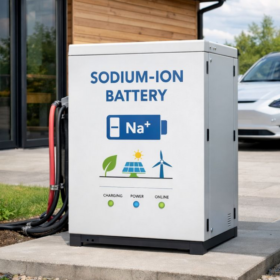
NanoMalaysia unveils sodium-ion prototype surpassing 300 Wh/kg
The new prototype ranks among the most advanced sodium‑ion battery systems reported worldwide.

Longi launches fire-resistant solar module for rooftop PV
The Chinese manufacturer has launched a fire-resistant version of its Hi-MO X10 module for distributed PV applications, featuring back-contact technology and up to 24.8% efficiency. The company says the module adds enhanced fire-safety design to address rooftop PV risks such as hot spots and DC arcing.
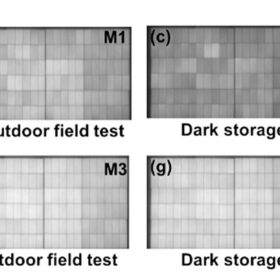
TOPCon solar modules show self-healing under UV stress
Researchers from Nanchang University and Trina Solar found that TOPCon solar modules exhibit metastable “degradation–recovery” under UV exposure, with light soaking fully restoring performance and no impact on real-world energy yield. Their findings highlight the need to refine UV testing standards to better reflect field performance and guide PV reliability assessments.
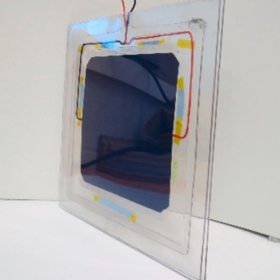
First attempt to build solar modules using polycarbonate encapsulant
Canadian researchers proposed a laminate-free solar module using polycarbonate instead of EVA and glass. The new encapsulation technique reportedly enables easy disassembly, reuse of solar cells, and open-source local manufacturing.
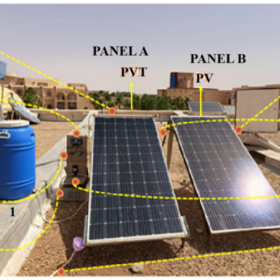
Water-spray cooling can improve PV module efficiency by 28% in arid environments
An Algerian research team has developed a smart water-spray cooling system for PV panels that activates only when temperatures exceed a set threshold, boosting efficiency while minimizing water use in desert conditions. The system raised power output and reduced module temperatures, offering similar efficiency to continuous cooling but with far lower water consumption, pump operation, and costs.
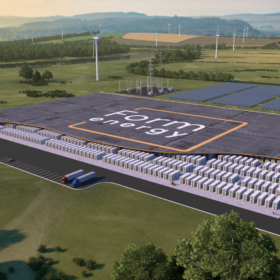
Small 24/7 clean power commitments could cut costs for long-duration storage
TU Berlin researchers say early demand for round-the-clock carbon-free electricity could help bring advanced energy technologies to market faster through technology learning effects. Grant funding for the research was provided by Google, which has since announced plans to build the world’s largest iron-air battery.

Thermocold debuts air-to-water heat pump for commercial buildings
The new product line covers 124–644 kW in heating and 128–632 kW in cooling, operates down to -15 C, and supports various configurations with R454B or R410a refrigerants.
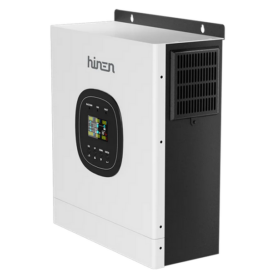
Hinen releases residential off-grid inverter
The 3 kW N3300S inverter combines a pure sine wave inverter with an integrated MPPT solar charge controller for small residential and hybrid PV systems. The unit supports multiple power sources, flexible battery chemistries, and rapid grid/off-grid switching.

Growing pains: Grid congestion as a renewables bottleneck
The electricity grid is a real bottleneck for energy in the United States, and it’s not only utilities and grid operators who are struggling. Grid congestion also puts pressure on renewable energy project owners and is as much a business problem as it is a technical one, writes Alon Mashkovich, CEO of energy management business software supplier enSights.
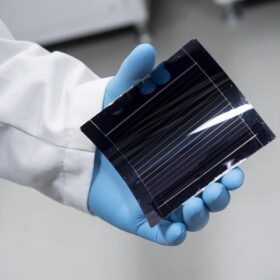
Why CIGS solar keeps lagging behind crystalline silicon
In an interview with pv magazine, Empa scientist Mirjana Dimitrievska explains that the CIGS photovoltaic technology, while promising for efficiency and flexible applications, faces persistent challenges in scaling lab-level performance to cost-effective, high-throughput industrial production, limiting its ability to compete with crystalline silicon. She also emphasizes that long-term stability, reliability, and material sustainability, rather than peak efficiency, are crucial for commercial viability, especially in niche markets like building-integrated and lightweight PV.
