
Germany wraps up ‘innovative’ tender with average price of €0.0709/kWh
Germany has concluded a new renewables tender, securing 583 MW of capacity at an average price of €0.0709 ($0.0771)/kWh.
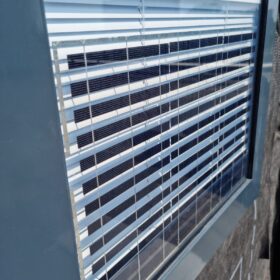
TNO researchers build world’s first bifacial PV window
The new multifunctional PV window concept aims to produce electricity while providing over-heating protection for better indoor thermal and visual comfort. It consists of an insulating glazing unit with bifacial crystalline silicon solar cells strips and embedded venetian blinds that act as reflectors for the rear side of the cells.
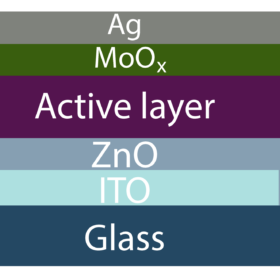
Organic PV module based on ultra-narrow interconnections achieves record-breaking efficiency of 16.1%
New research from China shows that ultra-narrow interconnections may considerably improve organic PV performance. The scientists built a 11.08 cm2 panel with an impressive geometric fill factor of 98%.

PV fault detection method based on deep learning of aerial images
Conceived an international research group, the proposed model uses the convolutional neural network (CNN) architecture U-Net for image segmentation and the the CNN architecture InceptionV3-Net for fault classification.
Redback presents home battery, inverter range
Battery and inverter manufacturer Redback Technologies has bounced back from a tumultuous start to the year – including a short stint in voluntary administration – with the launch of a new range of solar and energy storage products.

Research on agrivoltaics in Germany demonstrates strong synergies
Recent research conducted by Germany’s Fraunhofer ISE on agrivoltaics show that not only did the crops grown under the PV panels benefit from the partial shading, but also that the PV system produced more electricity than previously assumed thanks to the cooling provided by the plants underneath.
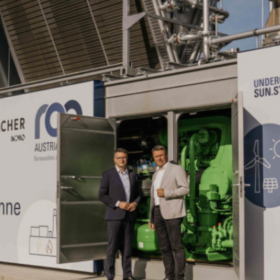
The Hydrogen Stream: Innio starts hydrogen-fueled CHP plant in Austria
Innio Group has started operating a combined heat and power (CHP) plant for heating purposes in Austria, while PureWave Hydrogen has told pv magazine that it is exploring geological hydrogen in Kansas using proprietary software and an AI system.
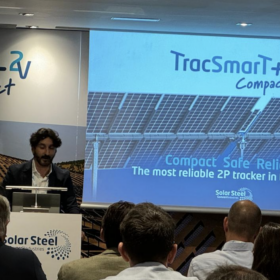
Gonvarri Solar Steel unveils new tracker
Spain’s Gonvarri Solar Steel claims that its new single-row tracker can improve structural stability and performance in adverse conditions.

Japan’s oldest PV system gets refurbished
Tokyo-based startup Girasol Energy and the enterprise bureau of Japan’s Yamanashi prefecture have repowered Japan’s oldest PV system, a 100 kW array built in 1993. The project aimed to partially replace the original 13.3% efficient solar modules, offering an alternative to dismantling and recycling the system’s components.
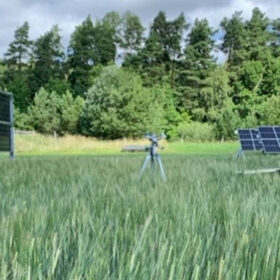
Vertical agrivoltaics for barley
Researchers in Sweden have measured barney yield in a vertical agrivoltaic facility and have found that despite the shade created by the modules the yields are comparable to open-field control conditions, if not slightly higher. Their methodology can be replicated for other sites and crops.
