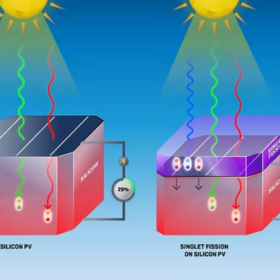
Singlet fission research breakthrough unlocks high solar cell efficiency
University of New South Wales (UNSW) researchers have filed patent protection and are working to scale production of a new class of photostable organic molecules proven to boost silicon solar cell efficiency, reduce heat and extend panel lifetimes using singlet fission.

Building-integrated concentrating photovoltaics for vertical applications
An Indian-British research team has developed a building-integrated linear concentrating PV facade by sandwiching an asymmetric compound parabolic concentrator, PERC cells, and encapsulation layers between two sheets of glass. The system was tested under both indoor and outdoor conditions and its payback period was found to be of up to 11 years.

DAS Solar developing 23%-efficient silicon solar cell based on carbon nanotubes
The Chinese module maker said the solar cell was developed with the support of Hebei University. The device uses a carbon nanotube-based hole transport layer that could be used in TOPCon and HJT structures to boost output and reduce complexity.
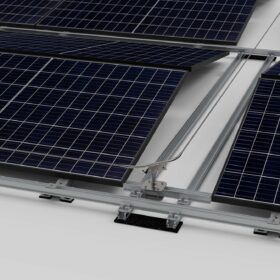
Smartvolt adds rooftop lightning protection to pre-assembled mounting system
The Swiss mounting system manufacturer has added new safety features to its pre-assembled, foldable SmartSolarBox solution for flat roofs and temporary sites, as well as support for larger 600 W modules.

Most of China’s coastal solar is in low-risk typhoon areas
A Beijing-based research team has analyzed the risk to typhoons experienced by solar farms in China’s coastal regions. It found 84% of photovoltaic expansion has occurred in areas at low risk to typhoons.
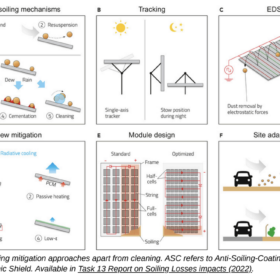
IEA-PVPS warns soiling costs solar industry billions per year
The International Energy Agency’s Photovoltaic Power Systems Programme (IEA-PVPS) says dust, pollution, and debris on solar panels reduce output by 4% to 7% worldwide, costing the industry billions of euros annually and making tailored mitigation increasingly urgent.
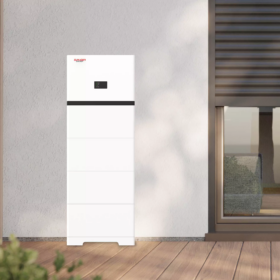
Sunwoda Energy unveils 40 kWh storage system for homes, businesses
Chinese manufacturer Sunwoda Energy introduced a modular all-in-one energy storage system with up to 40 kWh capacity and 30 kW output for residential and small commercial use.

Brazil opens consultation on nationwide smart meter deployment
Brazil’s Ministry of Mines and Energy (MME) has launched a consultation that could lead to the installation of 3.6 million smart meters as part of efforts to modernize the power sector and cut losses.
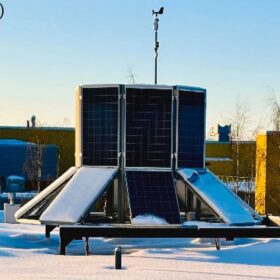
Carousel-shaped measurement platform for Arctic PV
Scientists in Finland have created a special platform to assess the performance of PV modules operating under Arctic conditions. Specifically, it provides data for efficient system design and performance modelling validation, with azimuth and tilt angle being key parameters.
New control strategy for grid-forming inverters
Researchers in the United States have created a droop control strategy for grid-forming inverters that purportedly improves power system frequency stability. By using an exponential active power–frequency relationship, the novel technique optimizes the use of available headroom, reduces frequency deviations, and enhances overall grid resilience.
