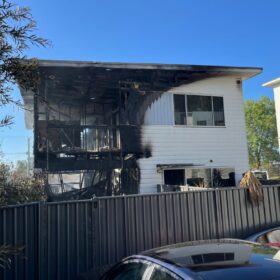
‘Compromised’ battery blamed for fatal house fire in Australia
Fire investigators in the Australian state of New South Wales have determined that a compromised lithium-ion battery was the cause of a recent house fire north of Sydney that killed two people.
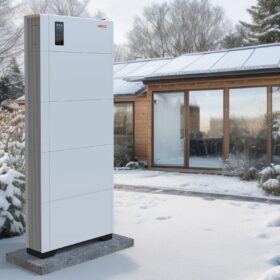
Weco launches new residential battery
The new product has a capacity of 5.4 kWh and is scalable up to 60 kWh. It features a depth of discharge of 100% and a rated charge-discharge voltage of 450 V.

New tool to calculate efficient earthworks for ground-mounted PV
A unit of French construction group Vinci has developed a new tool to ensure efficient earthworks for ground-mounted PV systems, with a focus on optimization parameters, design restrictions, allowable slopes for mounting structures, and terrain adaptation.
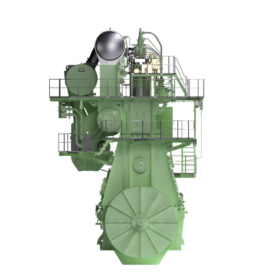
The Hydrogen Stream: Mitsui tests MAN B&W engine on hydrogen
Mitsui and MAN say they have converted a gas injection engine to hydrogen for the maritime industry, while 3M and HD Hyundai Korea Shipbuilding & Marine Engineering (KSOE) have agreed to develop large liquid hydrogen storage tanks.
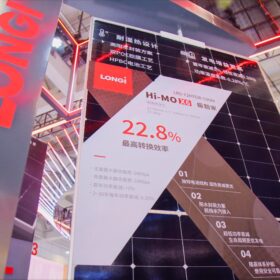
Longi introduces HPBC photovoltaic modules with 22.8% efficiency
The Chinese panel manufacturer said its new products have a temperature coefficient of -0.28%/C and a power output ranging from 565 W to 590 W. They rely on the company’s proprietary hybrid passivated back contact (HPBC) cell technology.
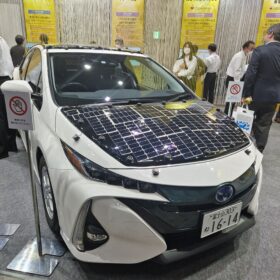
PV-powered cars and the parking dilemma
Researchers in Portugal have addressed the so-called ‘parking dilemma’ of electric cars incorporating photovoltaic modules. They looked into the tradeoff between charging the car and raising its inside temperature. They calculated the critical time as a function of the car’s solar capacity.
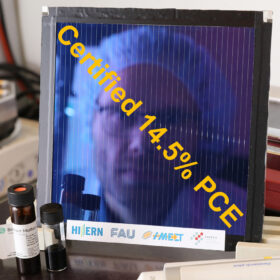
Large area organic PV module achieves world record efficiency of 14.5%
The module has a size of 143 mm x 143 mm and an active area of 204.11 cm². The result was certified by the Fraunhofer Institute for Solar Energy Systems (Fraunhofer ISE).
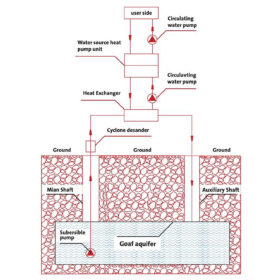
Abandonded mine water source heat pump system for residential applications
Chinese researchers have designed an abandoned mine water source heat pump system that can reportedly perform better than gas boilers in residential buildings. It consists of a submersible pump, a plate heat exchanger, a water source heat pump, a circulating water pump, and an end section.
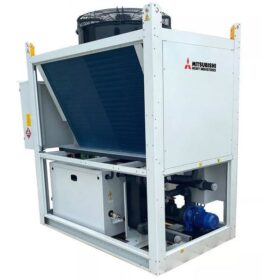
Mitsubishi Heavy Industries debuts air source inverter heat pump
Conceived for residential, commercial, and industrial applications, the Hydrolution PRO heat pump has a coefficient of performance of up to 3.47 and a seasonal coefficent of performance of up to 4.59. It uses difluoromethane (R32) as the refrigerant.
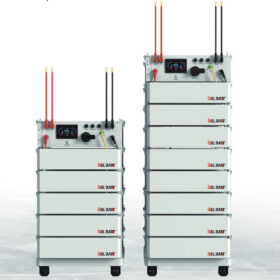
Bslbatt introduces high-voltage battery for commercial PV
China’s Bslbatt says its new batteries feature individual battery modules with voltages of 80 V to 1,000 V and a capacity of 135 Ah. They can be stacked in series with up to ten battery modules.
