
New solar carport from France
French pergola specialist Heolian has presented its new Atrium Electron carport solution. The system is equipped with 21.8%-efficient 425 W bifacial modules produced by French manufacturer Duoenergy and microinverters.
Longi launches anti-dust solar module for C&I segment
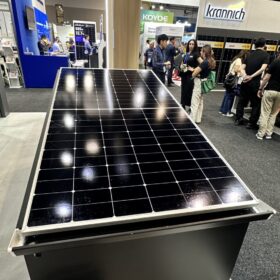
Chinese solar manufacturer Longi has developed a new “anti-dust” module for the commercial and industrial (C&I) market in Australia. The frame sits flush against the glass on the short side, allowing water to wash off.
Lightricity unveils indoor PV testing products
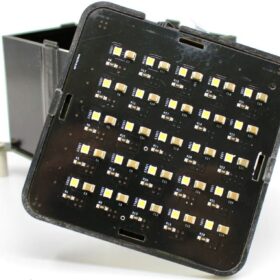
UK-based Lightricity, a spinoff of Oxford-based Sharp Laboratories of Europe, has launched testing equipment for indoor PV devices that are small enough to power wristwatches to larger ones meant for electronics devices and internet-of-things (IoT) sensors.
Perovskite-perovskite-silicon tandem solar cell achieves record-breaking efficiency of 27.1%
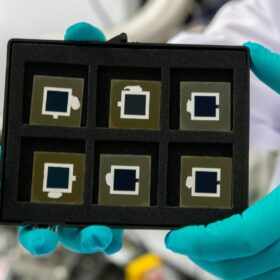
Researchers in Singapore have built a triple junction tandem solar cell with an ultrawide-bandgap perovskite absorber integrating cyanate (OCN) ions. The cell surpassed the power conversion efficiencies previously reported for all other perovskite-based triple-junction tandems, as well as single-junction perovskite and silicon solar cells.
Standard Energy unveils vanadium-ion battery with 1% degradation
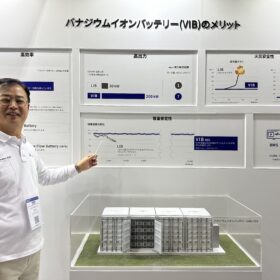
Vanadium offers unique characteristics as a battery material, as it can shed electrons without shifting from its ionic state, ensuring high cycling stability. South Korea’s Standard Energy has developed a battery with just 1% degradation after 20,000 cycles. The company has already completed 10 MWh of projects in its home market and now aims to expand internationally.
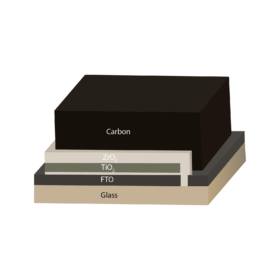
First attempt to build perovskite solar cell based on ionic liquids delivers 13.8% efficiency
North Korean researchers have designed a perovskite solar cell with an absorber treated with ionic liquids. The device reportedly offers improved passivation and fewer recombination losses.
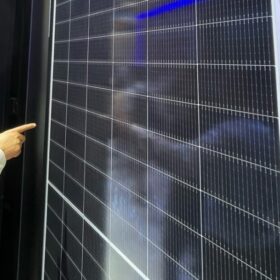
Italy offers fiscal breaks to PV projects built with EU-made solar modules
Italy’s new provisions state that fiscal credits can be awarded to PV project developers that use solar panels produced in the European Union with module efficiency ratings of more than 21.5%, or products with cell efficiencies above 23.5%. The fiscal credits will cover up to 35% of panel prices.
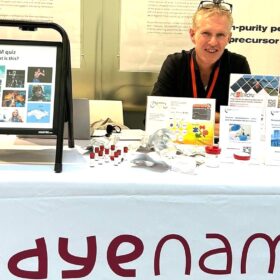
Dyenamo expands materials offer for perovskite-silicon tandem solar cells
In response to its customers’ needs, Sweden’s Dyenamo has added several new perovskite product lines and increased production of materials for the full range of perovskite solar cell designs.
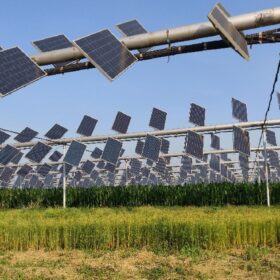
Vertical bifacial vs. stilted agrivoltaics
Scientists in Austria have conducted a life cycle assessement of vertical bifacial agrivoltaic systems and stilted agrivoltaic facilities. Their analysis revealed that vertical installations have lower environmental impacts in wide range of scenarios.

Chevron announces solar-to-hydrogen project in California
Oil giant Chevron said it expects its new solar-to-hydrogen project in California to produce about 2.2 tons of hydrogen per day by 2025.
