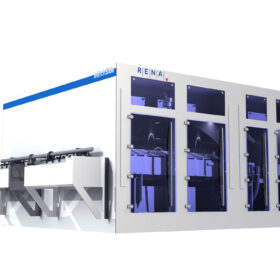
RENA announces 1.8 GW sale for new TOPCon equipment
German company RENA Technologies has announced the first sales of a new tool for silicon cell manufacturing. The tool is used for etching/removal of unwanted material on one side of a solar cell, and will be integrated into the gigawatt-scale production of an unnamed manufacturer in South Asia working with TOPCon technology.
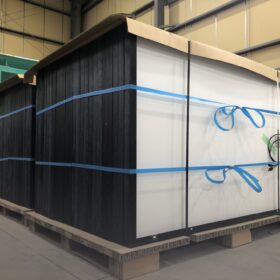
Marubeni, Hamada enter solar panel recycling business
Japan’s Marubeni and Hamada have launched Rexia Corporation to offer solar panel recycling and reuse services across the country, diverting material from landfill and giving a second life to older panels.
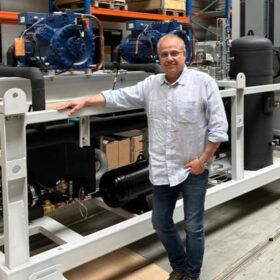
Industrial renewable heating system based on 780 kW heat pump
Israeli developer Tigi Solar is deploying an industrial heat pump to support the heating system at the facility of a food industry enterprise in Israel. The heat pump has an output of 780 kW and a coefficient of performance (COP) of 4.6. It uses existing ammonia chiller waste heat as the heat source and can reportedly provide a hot water temperature of 65 C.
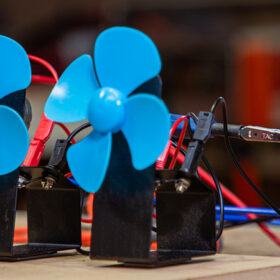
New proton batteries for megawatt-scale renewables storage
Engineers at Melbourne’s RMIT University have developed a rechargeable “proton battery” that has the potential to store more energy than currently available lithium-ion batteries.

Scotland greenlights 600 MW pumped hydro project
Drax Group said it will expand the pumped hydro storage capacity of the Cruachan Power Station by another 600 MW to 1,044 MW. However, the project will require greater policy support.

German startup offers app to maximize use of solar power surplus in homes
Clever-PV has developed a manufacturer-independent energy management solution for homes. The app is free to download from app stores and can be connected to PV systems, wall boxes, heat pumps, and other smart devices. This allows users to optimize the use of self-generated solar power.
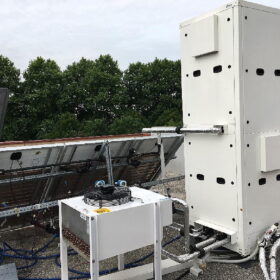
Residential heat pump based on finned coil evaporator, PVT collectors
Scientists in Italy have developed a 5 kW direct-expansion solar-assisted heat pump that uses alternatively two different evaporator technologies. The cooling of the PV module unit by CO2 evaporation increases power production by 8%.
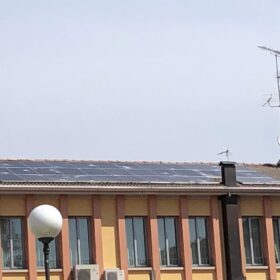
How big must hailstones be to damage PV systems?
The hail storms that occurred recently in northern Italy damaged several photovoltaic systems. pv magazine Italy retrieved a report from the Vrije Universiteit Amsterdam from 2019 which tried to shed light on the damage caused to solar installations by hail by analyzing the effects of a severe hailstorm that occurred in the Netherlands in 2016. According to their assessments, damages to PV modules are mostly derived from hailstones of at least 3 cm in diameter.
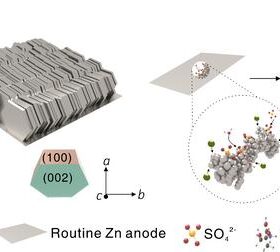
Aqueous zinc-ion battery with high stability
Researchers in China have found that the addition of serine cations to the electrode/electrolyte interface of aqueous zinc-ion battery could effectively inhibit zinc dendrite growth and enable a highly reversible zinc anode.

To achieve net zero energy status, solar-powered buildings should not exceed 10 floors
Researchers in Canada have found that nearly zero-energy buildings (NZEBs) with on-site solar energy generation should not exceed an energy use intensity (EUI) of 50 kWh/m2a, which they said corresponds to a maximum of 10 floors. They also ascertained that the maximum permitted EUI by net-zero energy status is 17–28 kWh/m2a.
