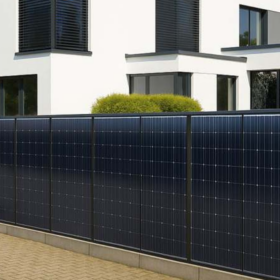
Clickcon launches solar PV fence for residential, commercial sites
The German mounting system specialist has developed a new vertical ground-mounted system compatible with commercially available framed PV modules.
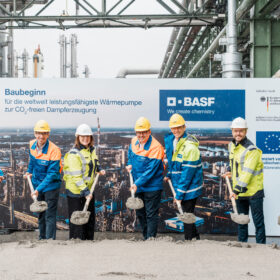
BASF begins building 50 MW industrial heat pump
Germany’s BASF has begun constructing an industrial-scale heat pump that will use electricity from renewables to produce up to 500,000 MT of CO2-free steam each year. Commissioning is scheduled for mid-2027.

Scientists report experimental breach of Shockley-Queisser efficiency limit for silicon solar cell
A Chinese-US research group claims to have achieved a power conversion efficiency of over 50% in an n-type single-junction solar cell by inhibiting light conversion to heat at extremely low temperatures. The result was achieved at temperatures of 30-50 Kelvin, which are a few tens of degrees above absolute zero.
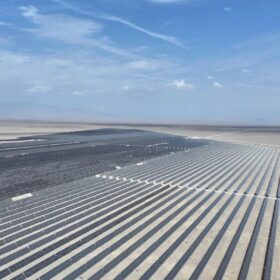
China Three Gorges commissions world’s largest PV-CSP solar plant
Hybrid project pairs a 100 MW linear Fresnel concentrated solar power (CSP) with a 900 MW PV facility, delivering 24-hour output and demonstrating large-scale storage integration.
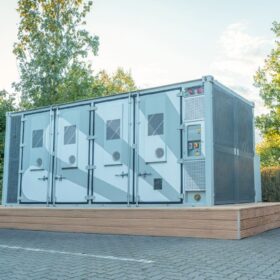
Europe’s largest sodium-ion battery installation goes live
Switzerland’s Phenogy has launched a megawatt-hour-scale sodium ion energy storage system at a commercial site near Bremen Airport in northern Germany. With this project, the Swiss manufacturer is making its debut on the European energy storage scene, backed by ambitions to develop fully vertically integrated local manufacturing.

Agrivoltaics for arboriculture
Swiss company Insolight inaugurated a 250 kW agrivoltaic installation on apple, pear, and apricot orchards in Conthey, producing 300 MWh per year for the grid, in collaboration with Agroscope, Romande Energie, and the canton of Valais.

EU policies could cut cost gap between European and Chinese solar modules
A report by SolarPower Europe and Fraunhofer ISE finds EU-made solar modules cost €0.103 ($0.12)/W more than Chinese imports, but targeted policies could close the gap and help reach the EU’s 30 GW annual manufacturing target by 2030.
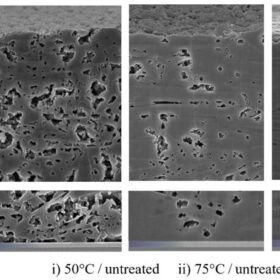
Perovskite solar cells with laminated carbon electrodes reach 20.4% efficiency
Scientists in Germany report a method to boost performance of perovskite solar cells made with laminated carbon electrodes that are compatible with typical hole transport layers.
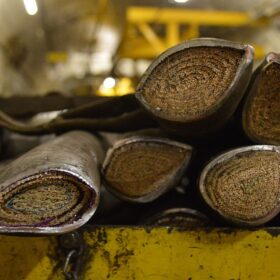
Thieves steal 50 km of cable from 11 MW solar farm in Germany
Thieves stole 50 km of cable worth about €100,000 ($117,400) from an 11 MW solar project in southern Germany, with repair costs expected to exceed the material loss, according to police.
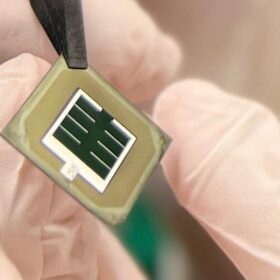
The impact of sunlight spectral shifts on bifacial perovskite-silicon tandem solar cells
Experts from the International Solar Energy Society explains how regional spectral shifts of the standard spectral distribution of sunlight bring new insights into the performance of bifacial perovskite-silicon tandem solar cells.
