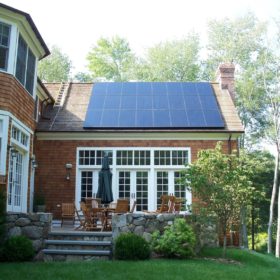
Solar 101: It all comes down to curb appeal
The residential solar industry has taken notice of the demand for beautiful, hidden panels, and is now providing creative and attractive designs that you can incorporate into your rooftop solar project.

Flexible perovskite solar module with 10.5% efficiency
The methylammonium-free inverted solar module was built on a flexible substrate made of polyethylene terephthalate (PET). A hole transporting material made of poly(triarylamine) (PTAA) and a double-cation cesium formamidinium (CsFA) perovskite layer were deposited through blade-coating and nitrogen-assisted blade-coating.
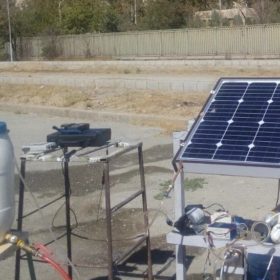
Stand-alone brackish water desalination system powered by photovoltaic-thermal unit
The BWRO unit, which has a treated water production capacity of around 11.80 L/h, was built with a pre-filtration module, a high-pressure DC pump, an RO module, and a post-treatment module. The PVT system was designed to meet the energy requirement of a high-pressure DC pump and a diaphragm-type circulation pump utilized to circulate soft water beneath the PV module for the active cooling of the panel itself.
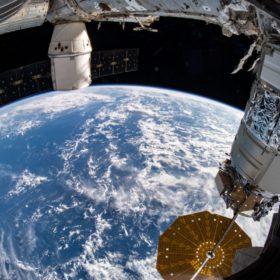
Roll-out solar arrays installed in successful NASA spacewalk
The first new ISS Roll-Out Solar Array (iROSA) has been installed on the International Space Station.

Saule Technologies opens perovskite solar cell factory in Poland
The Polish perovskite solar cell specialist claims to be the first company in the world to have commissioned commercial production of the technology.
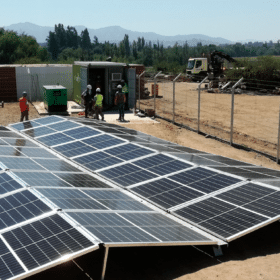
Plug-and-play mobile PV system to power solar parks’ construction sites
A Spanish renewable energy company has installed its first, pilot mobile PV unit at a new detention center in Chile.
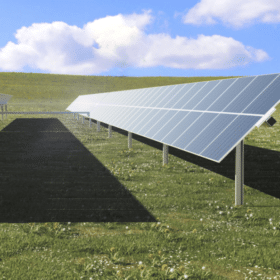
Soltec launches tracker for high-power modules
The SFOne tracker is designed for modules with 72 and 78-cell designs. According to Soltec, it reduces the time spent in its installation by 75% and will be available in all markets where the company operates.
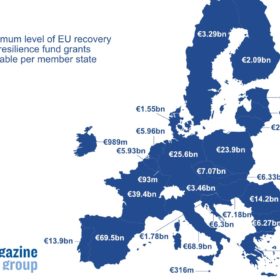
Spain to devote €3.9bn of EU cash to ‘innovative renewables’
The investment has been planned as part of the nation’s recovery and resilience plan to access EU funds for its post-Covid economic stimulus package. The spending plans of Portugal and Greece have also been approved by the European Commission in the last 48 hours.

Roundtables Europe Video: Maintaining PV quality alongside rapid technological development
The adoption of new technology is required to grow and maintain PV’s place in the energy transition. Thankfully, the rate of change within PV technology is accelerating, pointing to a bright future. But what quality risks are emerging from these new technologies? And how can they be managed? Watch the first of four videos from our pv magazine Roundtables Europe event to find out.

Is large scale solar ready for the North Pole?
Norwegian researchers have conducted a study to assess the technical feasibility of solar parks in polar regions. They found out that snowdrifts may be a major issue but they also believe that snow accumulation can be reduced through snow fences and proper system design.
