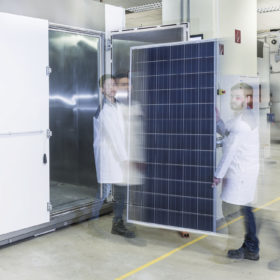
The weekend read: Is PERC still bankable?
Light-induced initial degradation in PERC modules is currently a subject of intense discussion, but tests at PI Berlin have shown that the problem is solvable. Founder and CEO Paul Grunow explains the effects, the approach, and the results.
Trina Solar begins mass production of 425 W bifacial glass-glass module
The Chinese PV manufacturer uses TOPCon half cells for the modules. The additional rear side yield is estimated by Trina at 5-30%.
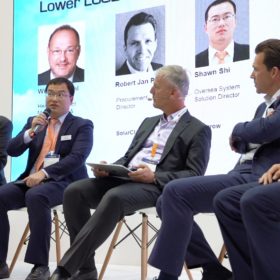
Video: Longi launched the HiMo4 mono-PERC series at Intersolar Europe
Winfried Wahl, head of product management at Longi Solar spoke to pv magazine about how the HiMo4 has a 15% higher power output than the previous iteration in the series.

How to capitalize on the Chinese clean energy juggernaut
Flying in the face of claims the rise of China’s clean energy sector undermines the security of developed nations and harms the profitability of their businesses, a research paper argues such a view is outdated and ill-advised. It presents four opportunities for Western players to tap ‘Green China Inc’.

Green hydrogen airs at G20 meeting of energy ministers this week
Hello hydrogen! A number of factors are floating renewably powered hydrogen to the top of the agenda for worldwide energy ministers. Australia is among the countries most favourably placed to turn hydrogen hype into the biggest source of decarbonized energy the world has yet seen.

MIT works to refine the flow of promising perovskites
Scientists at the Massachusetts Institute of Technology have developed an accelerated process for screening new perovskite compounds as they search for those with the potential to be used in high efficiency solar cells. According to MIT, the process speeds up the synthesis and analysis of new compounds by a factor of ten and has already highlighted two sets of materials worthy of further study.
Five hot PV module and cell takeaways from SNEC
While lacking the swarming crowds of previous years, the 2019 SNEC in Shanghai remained a focal point of the global PV industry when it comes to industrial solar cell and module manufacturing and technology. Here are five hot technology takeaways from the pv magazine team on the show floor and conference sessions.
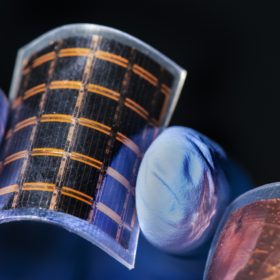
Nothing can bring down the price of III-V solar cells – just add germanium
A research paper from scientists at the U.S. National Renewable Energy Laboratory outlines a new approach to the production of gallium arsenide based cells. The approach, termed ‘germanium on nothing’, could enable the cost effective, high volume production of PV cells based on III-V materials such as gallium arsenide.
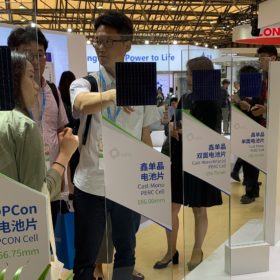
Innovation and uncertainty mark SNEC 2019
There was plenty of innovation on display at this year’s SNEC, which closed yesterday afternoon at the Shanghai New International Expo Center. The three-day exhibition ran from Tuesday to Thursday, was well attended and still ranks as the world’s largest solar energy trade show.
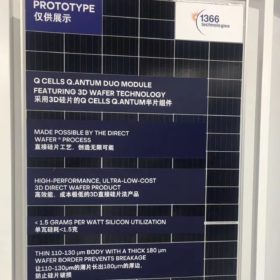
Prototype modules featuring ‘3D wafers’ on show at SNEC
New modules incorporating American company 1366 Technologies’ 3D direct wafers were unveiled yesterday at the SNEC trade show in Shanghai. The prototype modules are produced by Korean manufacturer Hanwha Q Cells. The two companies have a strategic partnership going back several years, and are ramping up a wafer factory near Q Cells’ module facilities in Malaysia.
