
Researching some cool new battery materials
Scientists from China and the United States have developed an additive for electrolyte materials they say could improve the operating temperature range for lithium-ion batteries, allowing them to operate down to minus 40 degrees Celsius without compromising performance at temperatures up to 60 degrees Celsius.
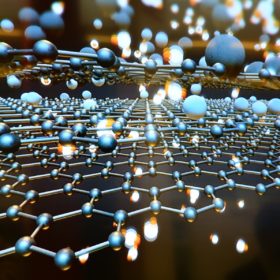
Researchers develop method to synthesize graphene from abundant eucalyptus bark
Australian and Indian scientists have developed a method of manufacturing soluble graphene in a cost-effective and eco-friendly way from one of Australia’s most common resources, gum trees.

Renewables and geopolitics: water and sun pivots to new world order
In our series of renewable energy and geopolitics interviews, Indra Øverland – head of the Center for Energy Research at the Norwegian Institute for International Affairs – explains why hydropower can be the perfect match for intermittent renewables such as solar and wind. Hydropower assets are one of the biggest geopolitical stories of the energy transition but receive almost no attention. Nations with strong hydro potential may become linchpins of regional renewable energy.
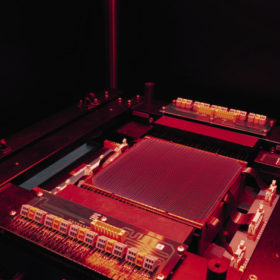
The weekend read: One side or two
Bifacial modules are here to stay. But even as manufacturers commit further capacities to two-sided module production spanning a whole range of technologies, there are still challenges to overcome, to fulfill predictions that bifacial will represent almost 40% of all modules produced inside the next decade. Flash testing conducted at the end of cell and module production presents one of these, and there is plenty of debate among equipment suppliers as to how this manufacturing stage should treat bifacial cells and modules.
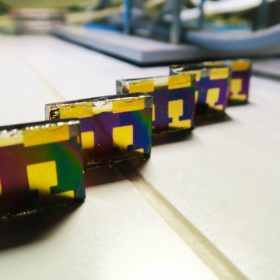
EPFL scientists put perovskite through its paces
Scientists working at Switzerland’s École Polytechnique Fédérale de Lausanne, in the lab of renowned PV scientist Michael Grätzel, have developed a new method for testing perovskite solar cells that they say combines the advantages of laboratory and outdoor testing and will contribute to the creation of industry standards for characterizing perovskite stability.
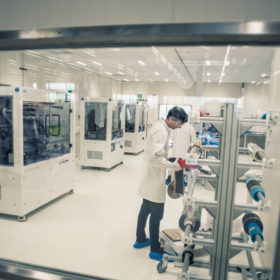
Solid (state) plans announced by imec
Belgian research institute imec this week said it has set a performance record of 400 watt-hours per liter – at a charge rate of 0.5 – for a solid state lithium metal battery. The institute says it is working with the University of Hasselt to scale up production of solid state cells on a pilot line in Belgium.
IEA report outlines ‘Future of Hydrogen’
The G20 meeting of environment and energy ministers on the weekend in Karuizawa, Japan, came out largely in favor of adopting lower-emission energy technologies. That means cleaner coal, as well as the development of solar- and wind-powered green hydrogen.
The weekend read: Is PERC still bankable?
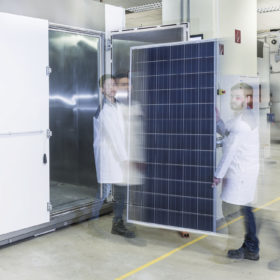
Light-induced initial degradation in PERC modules is currently a subject of intense discussion, but tests at PI Berlin have shown that the problem is solvable. Founder and CEO Paul Grunow explains the effects, the approach, and the results.

Trina Solar begins mass production of 425 W bifacial glass-glass module
The Chinese PV manufacturer uses TOPCon half cells for the modules. The additional rear side yield is estimated by Trina at 5-30%.
Video: Longi launched the HiMo4 mono-PERC series at Intersolar Europe
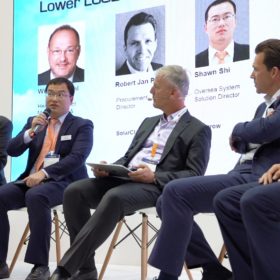
Winfried Wahl, head of product management at Longi Solar spoke to pv magazine about how the HiMo4 has a 15% higher power output than the previous iteration in the series.
