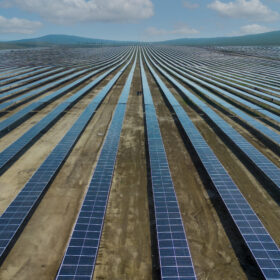
TotalEnergies, Masdar to merge renewables activities in nine Asian countries
The two major developers plan to establish a joint venture company with equal ownership that will be their sole vehicle for building, owning and operating both existing and future solar, storage and wind projects across nine Asian countries.
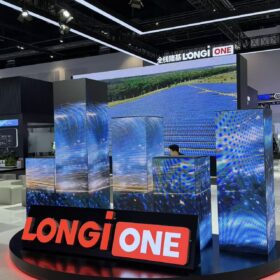
Longi launches integrated solar-plus-storage platform strategy
China-based solar manufacturer Longi is shifting from a multi-vendor system design to a unified solar-plus-storage architecture built around in-house technologies.
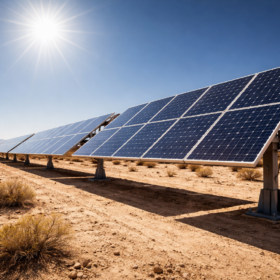
UNSW study finds tracker-based PV systems experience higher UV degradation than fixed-tilt arrays
New research from the University of New South Wales shows that PV module degradation varies widely with system design and location, driven by UV exposure, temperature, humidity, and atmospheric conditions. Tropical and desert regions face the highest stress, highlighting the need for climate-specific testing and system design.

US adds 26.6 GW of solar in 2025 as renewables dominate
Solar and wind accounted for nearly 90% of all new utility-scale generating capacity added to the US grid through December 2025, according to the Federal Energy Regulatory Commission (FERC).
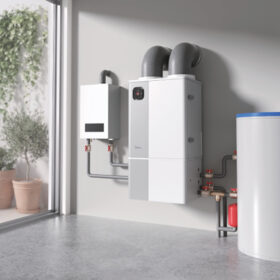
Midea unveils PV-compatible indoor heat pump for space-constrained residential applications
Midea has launched a compact indoor air-source heat pump for retrofit and space-constrained homes. The R290-based system offers up to 4.45 kW output, a coefficient of performance of 4.5 and smart PV-compatible controls.
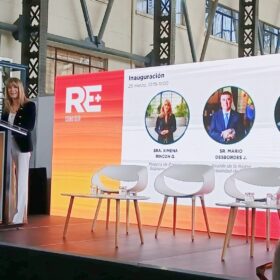
Key takeaways from Chile’s Re+ Cono sur
Chile’s Energy Minister Ximena Rincón called for a more proactive approach to renewables, storage, and electrification at the RE+ Southern Cone Summit last week, highlighting the need to reduce fossil fuel reliance and invest in enabling infrastructure.
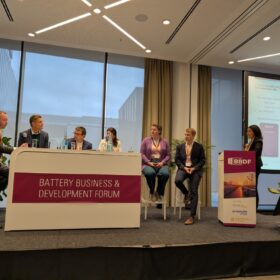
BBDF 2026: How financing standalone vs. co-located projects really works
The “lab” session at Battery Business & Development Forum 2026 made transparent how different stakeholders evaluate and view energy storage projects between standalone and co-located options, and where views diverged.
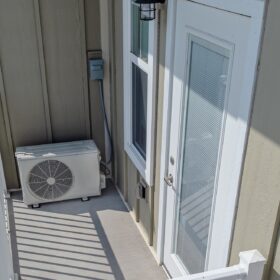
Germany’s heat pump public discourse is positive but volatile
Research from Germany analyzed sentiment in online news coverage to explore how heat pumps are portrayed in German public discourse. It found that while public perception is generally positive, it is neither uniform nor stable, and dipped significantly during debates around Germany’s heating law in 2023.
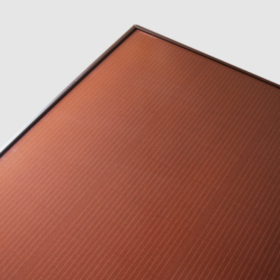
Solar Fabrik launches 400 W red-brown module for heritage roofs
Solar Fabrik has introduced a 400 W red-brown glass-glass PV module designed to meet strict aesthetic requirements for historic and protected buildings, offering a 20.02% efficiency and compatibility with traditional tiled rooftops.

BBDF: German network agency to release BESS grid fee framework soon
Germany’s Federal Network Agency (Bundesnetzagentur) is set to present a framework for future network fees in May 2026, with industry discussions highlighting how these charges could interact with flexible connection agreements and affect battery energy storage system (BESS) returns.
