
Optimum tilt angle for PV systems ranging from 0° to 90°
A Slovak research team has developed a mathematical model for determining the optimum tilt angle of a solar system ranging from 0° to 90°. Their framework was tested on an experimental setup in Czechia and attained 93.9% accuracy in predicting the system’s energy balance.
Japan launches subsidies to accelerate perovskite solar deployment
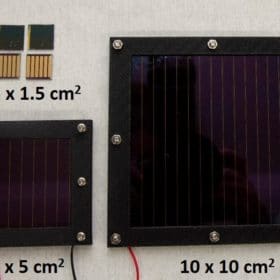
The Japanese government has launched applications for two targeted funding schemes to accelerate deployment of lightweight perovskite solar tech and incentivize battery-backed systems that enhance grid resilience and economic viability.

EBRD to support solar, storage, wind tenders in Jordan
The European Bank for Reconstruction and Development (EBRD) is working with Jordanian authorities to support three renewable energy tenders in the country, including a 200 MW solar project and a 100 MWh storage project.

Brookfield, Solarvest partner on 1.5 GW of solar-plus-storage in Malaysia
The two parties have signed a joint investment framework agreement to develop, construct and operate 1.5 GW worth of solar-plus-storage projects in Malaysia over the next three to five years.

US steel crunch puts solar deployment plans at risk
With US domestic steel mills booked solid through 2025, a sudden doubling of tariffs on imported steel has created a critical bottleneck for American industries. The move, which hits specialized Indian steel particularly hard, is now delaying projects for builders and renewable energy developers who rely on steady, affordable supply.

Seven projects pulled from EU hydrogen fund
The projects, equivalent to 1.88 GW of electrolyzer capacity, were withdrawn after choosing not to continue with the agreement procedure or for being unable to provide a signed completion guarantee. As a result, ten hydrogen projects representing 774 MW in capacity from the reserve list have been invited to prepare grant agreements.

Solar-Fabrik debuts back-contact solar module for residential, C&I applications
The German manufacturer said its full-black back-contact solar panel has a power conversion efficiency of up to 23.52%.
China building 1.8 GW offshore PV project in Bohai Sea
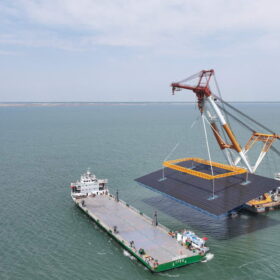
A state-led 1.8 GW offshore PV plan in Changli, China’s Hebei province, is set to become a model for large-scale marine solar development, with completion targeted by mid-2026.
Stochastic optimization for PV-powered EV charging stations
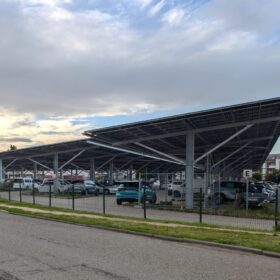
Scientists have developed a new optimization approach that combines both day-ahead optimization and real-time optimization to improve operations of PV-driven EV charging stations. The framework is based on the autoregressive moving average and the Latin hypercube sampling models.

Xpanner launches robotic automation kit to retrofit solar pile drivers
The U.S. startup offers a new kit to integrate robotic automation with existing equipment.
