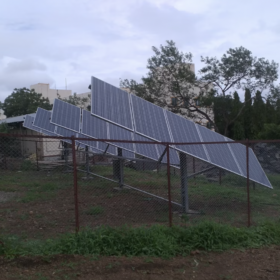
India’s MSEDCL tenders 2 GW/4 GWh of grid-connected battery storage
India’s Maharashtra State Electricity Distribution Co. Ltd. (MSEDCL) has issued a tender for 2 GW/4 GWh of battery energy storage systems (BESS) at sites connected to the intra-state grid. Developers will be selected to deploy the systems across MSEDCL-designated locations.
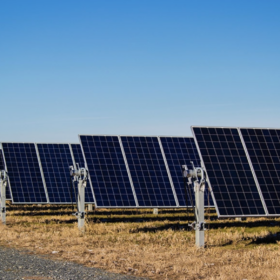
Australia expands Capacity Investment Scheme to target 40 GW of renewables
The Australian federal government is scaling up its support for renewables, expanding its flagship Capacity Investment Scheme in a bid to accelerate the nation’s clean energy transition.
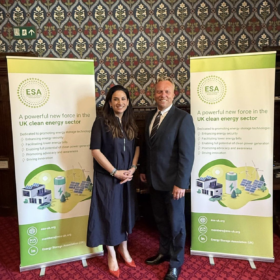
UK needs to get “obsessed” with energy storage, says ESA founder
Energy Storage Association (ESA) founder Jason Howlett tells ESS News learning lessons from other markets can ensure Great Britain avoids levels of negative pricing seen in elsewhere, as pace of UK renewables deployment is poised to ramp up.
US lifts duties on certain small solar devices imported from China
The US Department of Commerce will lift trade duties on certain low-power solar devices from China, citing limited domestic interest in maintaining the tariffs. The decision affects small modules typically used in lighting and other control applications.
APG to invest $650 million in Octopus Australia renewables platform
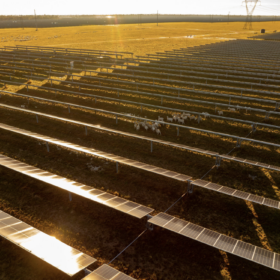
Dutch pension fund giant APG Asset Management has committed more than AUD 1 billion ($650 million) to expand the renewable energy platform of developer Octopus Australia.

China’s PV output, profits fall in H1 despite record installations
China’s PV sector faced steep declines in upstream output and margins in the first half of 2025, as oversupply and price declines weighed on manufacturers, according to the China Photovoltaic Industry Association (CPIA).
Why strategy is key: Lessons from real-world benchmarks
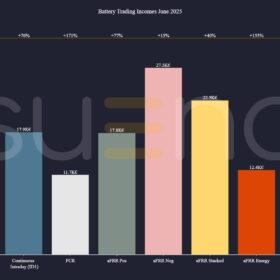
Maximizing value from battery energy storage systems (BESS) isn’t just about having the right hardware – it’s about executing the right strategy. Lennard Wilkening, CEO and co-founder of Germany’s suena energy, explores what makes standalone BESS profitable in increasingly competitive and volatile market, and what real-world benchmarks, such as suena energy’s monthly revenue update, reveal about the role of dynamic multi-market optimization.

Perovskite rollout gathers pace
Perovskite’s growing visibility at industry events in 2025 is a sign that perovskites have progressed beyond the small lab-made devices seen earlier this decade. The focus is now on developing materials, processes, and a supply chain ready for large-scale manufacturing and deployment.
Gallium arsenide solar cells radiation-resilient for space applications
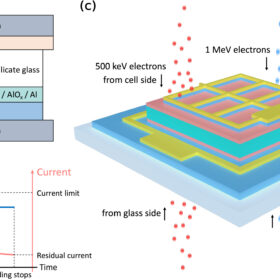
A group led by Cambridge University has developed an adhesive-free method of bonding ultra-thin gallium arsenide solar cells to borosilicate glass. The proposed technique is reportedly compatible with standard planar device processing.
TotalEnergies starts building 1 GW solar plant in southern Iraq
France’s TotalEnergies has broken ground on a 1 GW solar project in Iraq. The first 250 MW phase is due to come online before the end of this year.
