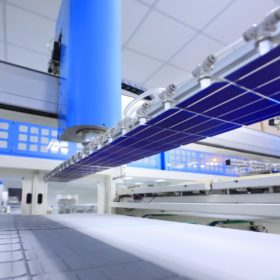
Chinese manufacturers join forces to build 5 GW module factory
Chinese solar manufacturers Seraphim and Lu’An Solar will invest around $565 million in the new factory.

New Michael Moore film claims environmental leaders ‘sold out to corporate interests’
“As we suffer through one health and environmental crisis after another, it is clear we can no longer simply solar-panel-and-windmill our way out of this emergency,” say producer Michael Moore and author Jeff Gibbs.

India installed 1.53 GW of rooftop solar in 2019
The country’s cumulative installed rooftop solar capacity reached 5.4 GW by the end of December. The Indian government now aims to deploy 40 GW of rooftop PV by the end of 2023.

Pakistani regulator expects solar capacity to hit 27 GW by 2047
Solar and wind are expected to account for a growing share of the electricity mix in the years ahead, rising from around 3% at present to 23% by 2030. Over the following two decades after that, however, this share will likely remain unchanged, as the national regulator expects the country to deploy more coal-fired generation capacity.
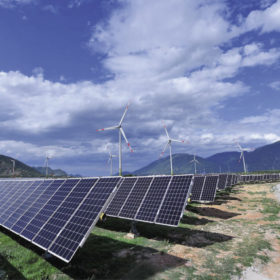
Australian grid could derive 75% of electricity from renewables by 2025
The Australian Energy Market Operator (AEMO) claims that the country already has the technical ability to safely operate a system in which three-quarters of the electricity comes from wind and solar. However, it needs to get the regulations right in order to do so.

Indian Railways tenders for 1 GW of solar
Developers have until June 30 to lodge bids to develop plots of solar capacity across the national rail network which offer a maximum INR2.71/kWh ($0.036) for the electricity generated under a 25-year contract.

Chinese coal miner starts work on world’s biggest solar-powered hydrogen facility
Baofeng Energy appears to be switching its focus to hydrogen production and says its new project will be powered by two 100 MW solar plants and will start producing 160 million cubic meters of hydrogen annually from next year.
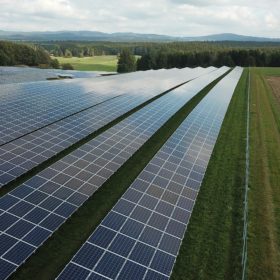
LCOE from large scale PV fell 4% to $50 per megawatt-hour in six months
Analysts at Bloomberg New Energy Finance say the lowest-cost projects financed in Australia, China, Chile and the UAE in the last six months hit a levelized cost of energy of just $23-29/MWh and the best solar and wind projects will produce electricity for less than $20/MWh by 2030.

Solar, wind and hydro resilient during Covid-19 crisis
A study by the International Energy Agency into the chilling effect of the Covid-19 pandemic on energy demand states renewables will be ‘the only energy source likely to experience demand growth for the rest of 2020’. The slower the economic recovery, the more the fossil fuel industry will suffer.

Mini perovskite module with 18.13% efficiency
Scientists from Singapore have developed semi-transparent perovskite solar cells that can be easily integrated into a range of urban contexts, including building facades, gates and windows. The 21cm2 mini panels are made of perovskite solar cells based on methylammonium lead iodine (MAPbI3), with an efficiency of 20.28% for 0.16 cm2.
