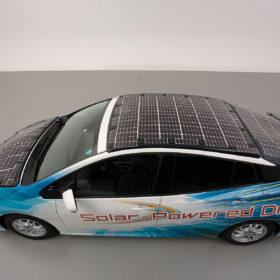
Toyota shows off solar Prius with 860 W output from 34% efficient cells
The car will be road tested at Toyota City in Japan. Solar charging technology for the vehicle will then be further optimized before the vehicle goes on sale.
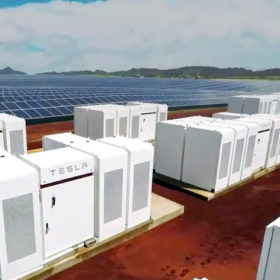
The United States is headed for a battery breakthrough
A new report by the Energy Information Administration projects U.S. installed battery storage capacity will reach 2.5 GW by 2023. Florida and New York are set to pave the way as massive projects in each state will account for almost half the coming capacity.
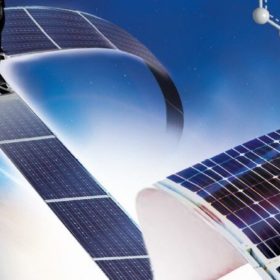
Russian scientists send organic PV into orbit
Scientists at Russia’s Skoltech Institute of Science and Technology have demonstrated a solar cell with record high radiation stability. The scientists say the cells, based on an organic polymer compound, could be a strong candidate to meet the requirements of powering satellites in lower earth orbit.

Shell, Sumitomo invest in LO3 Energy to develop blockchain-based community microgrids
Two corporate heavyweights have announced investments in the New York-based developer and operator of peer-to-peer energy platforms. The funding will allow LO3 to scale its blockchain-based community energy networks worldwide.
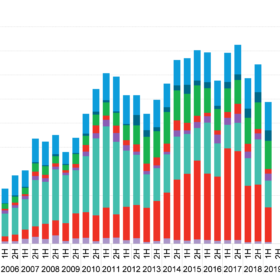
Global renewables investment fell in the first half of this year
While Spain, Sweden, Ukraine and Brazil attracted more funds than last year, China’s transition to an auction-based procurement system and slow performance overall in Europe saw worldwide backing decrease. BloombergNEF does expect investments to ramp up in the second half, however.

Colombia to award longer PPAs in renewables auction
Already postponed from June to September 30, the procurement will now be held by the end of October. The exercise will be open to new renewables projects with more than 5 MW of generation capacity. Selected developers will be awarded 15-year energy deals rather than the 12-year arrangements offered in February’s abortive attempt.
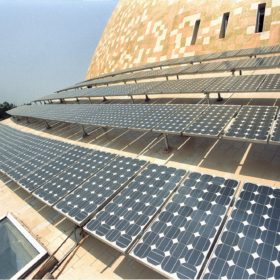
India added 1,836 MW of rooftop solar in last fiscal year
Maharashtra, Rajasthan, Gujarat, Karnataka and Tamil Nadu were the top five states by annual installation, accounting for 60% of the new capacity.
Tunisian module maker Ifrisol to increase capacity to 750 MW
The manufacturer plans to add 350 MW of manufacturing capacity at its two sites in Tunisia by next year. The ramping up is due to new orders from India and other foreign markets.

Morocco opens 230 MW solar tender
The Moroccan agency for sustainable energy is pre-qualifying developers for the Noor Midelt II project, a solar complex incorporating CSP and PV elements.
‘True grid parity about more than electricity price’
The head of Mercom Capital says solar has a long way to go before it can stand without policy support. Effective grid parity will only be achieved when the cost of PV electricity factors in the expense of grid upgrades and the storage systems its intermittent nature requires, says Raj Prabhu.
