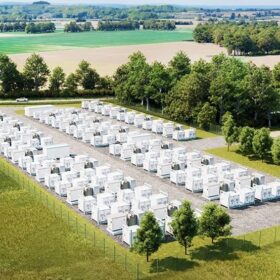
SMA Altenso to build 92.5 MW battery park in Germany
MEAG, the asset manager of Munich Re and Ergo Group, has acquired all shares in the ready-to-build storage project in the German state of North Rhine-Westphalia. SMA Altenso is to provide the full EPC and O&M services for the battery park, which is scheduled to go online in the second half of 2025.
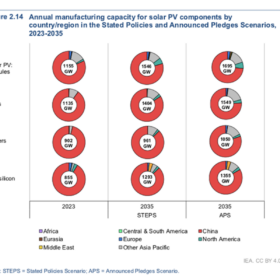
Solar module manufacturing capacity could exceed 1.5 TW by 2035, says IEA
The International Energy Agency’s (IEA) latest report, which maps out the future evolution of clean energy manufacturing, says the combined global market for PV, wind turbines, electric cars, batteries, electrolyzers, and heat pumps will rise from $700 billion in 2023 to more than $2 trillion by 2035.

South Korea launches 1 GW solar tender
South Korea’s Ministry of Trade, Industry and Energy (MOTIE) has kicked off a tender for 1 GW of solar and 1.8 GW of wind. The ceiling prices for solar contracts stands at KRW 157,307 ($113.69)/MWh.

PowerChina selects EPC contractor for 342 MW of solar in South Africa
Chinese civil engineering company PowerChina has signed an engineering, procurement, and construction (EPC) contract with developer SolarAfrica Energy for a 342 MW solar plant, to be built in South Africa’s Northern Cape province.

Energy storage more than half of new Italian grid capacity for 2025
Italian electricity transmission system operator Terna has published the results of 2025’s main capacity market auction.

European team targets 20%-efficient perovskite modules using industrial processes
The LUMINOSITY project consortium aims to develop 20%-efficient metal halide perovskite prototype modules measuring over 900 cm², designed for a 20-year lifespan and compatibility with roll-to-roll (R2R) processing.
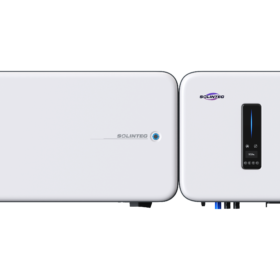
Solinteg launches new residential solar storage systems
Solinteg has developed the IntegOne HSH, a residential solar storage system that combines a single-phase hybrid inverter with one or two batteries. Up to 10 systems can connect in parallel, offering a maximum efficiency of 97.6%.

Flexible printed solar film research tacks closer to commercial viability
Australia’s scientific research agency CSIRO has taken its pilot-scale production of flexible printed solar film to a new level following the official launch of the new Printed Photovoltaic Facility in southwest Melbourne, Victoria.

Argentina inaugurates first commercial lithium hydroxide production plant
Part of mining company POSCO Argentina’s Sal de Oro integral lithium project, the plant was inaugurated at the General Güemes Industrial Park in the city of Salta. It is estimated to produce 25,000 tons of lithium hydroxide per year.
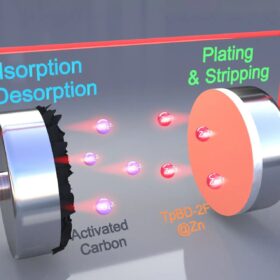
Researchers extend lifespan of aqueous zinc-ion batteries
The method developed at the Technical University of Munich is intended to make several hundred thousand charge and discharge cycles possible in the future instead of a few thousand. A special protective layer for the zinc anodes of the batteries is crucial.
