
Manufacturing partnership brings new PV technology to U.S.-sourced solar
Solx’s Aurora hybrid module with Caelux’s perovskite glass aims to compete on performance beyond federal tax sunsets.
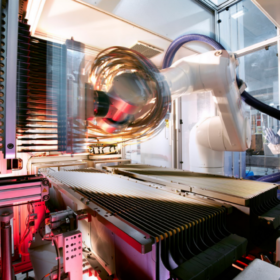
Trina Solar, JA Solar, JinkoSolar launch China’s first PV patent pool for TOPCon technologies
China’s solar industry has launched its first TOPCon-focused patent pool, led by Trina Solar, JA Solar, and JinkoSolar, to streamline licensing, reduce disputes, and strengthen IP coordination at home and abroad.

Sun’s out, load’s gone: The evolution of Australia’s National Electricity Market
Q4 2025 in South Australia saw grid-connected loads with spot price exposure actually being paid to use electricity about half the time (46%) – and that electricity was overwhelmingly (80%) supplied by renewables. This demonstrates a shift from managing demand to quietly needing it. Particularly in regions like South Australia, there is growing demand for demand.
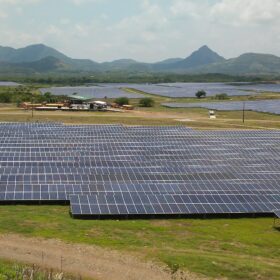
Solar delivers where wind and hydro falter
UK-based consultancy Ricardo, part of the WSP Group, explains how solar PV has compounded at 17% annually since 2016, defining the EU’s clean-energy trajectory. However, straightforward merchant returns are disappearing, and battery storage and grid expertise are now essential.

Zendure launches battery series for residential PV
Zendure is upping its to target the whole-home residential space, expanding on its plug-in balcony storage roots.
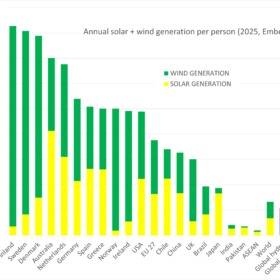
Solar and wind take over global power growth in 2025
In 2025, solar and wind dominated global energy growth, delivering around six times more new capacity than all other power sources combined and supplying nearly all new electricity demand. With rapid expansion led by countries like Australia and several European nations, solar and wind are now the fastest-growing and central drivers of the global energy transition.

Thermoacoustic heat pumps on the verge of commercial breakthrough
Dutch startup BlueHeart Energy is testing its thermoacoustic heat pump engine in residential settings, with a limited European launch expected in spring 2027, followed by gradual scaling. The system uses sound waves instead of refrigerants, aiming for quiet, flexible, low-maintenance heating suited especially for retrofits and renewable integration.

Forecasting solar irradiance in urban environments with just one 360° image
U.S. scientists have developed a method to forecast solar irradiance at any location using a single high-resolution hemispherical image captured on-site. By extracting sky, sun, and surrounding scene information from visual cues, the approach enables accurate long-term energy prediction without relying on detailed 3D city models.

Multi-pyranometer tech improves solar irradiance measurements in the Arctic
Norwegian researchers have developed a multi-pyranometer method to more accurately estimate global tilted irradiance (GTI) in the Arctic by separating beam, diffuse, and reflected solar components. Validated in the world’s northermost settlement, the approach was found to outperform conventional models in high-latitude conditions and improve PV system design for extreme environments.

Inside PV Manufacturing: Belga Solar’s module factory in Belgium
In the latest article of a new series on solar manufacturing facilities around the world, pv magazine presents Belga Solar’s solar manufacturing facility in Wallonia, Belgium.
