
Floating solar offers Morocco’s dams antidote to evaporation loss
Moroccan researchers say floating PV (FPV) installations on the country’s dams could simultaneously cut evaporation losses and generate electricity, but the country lacks a regulatory framework to enable large-scale deployment.

Egypt installs 800 MW of solar in 2025
Latest analysis from GlobalData expects Egypt’s annual solar additions to reach above 2 GW over the next three years, increasing to above 3.5 GW from 2029 onwards. Cumulative capacity is expected to grow from around 2.9 GW at the end of 2025 to 34.3 GW by the end of 2035.
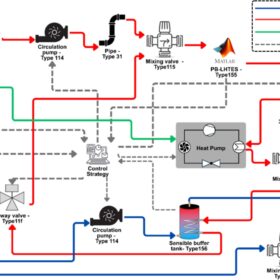
Hybrid latent-sensible storage can improve PVT-driven residential heat pump COP by 72.4%
A research team in Italy developed a PVT-driven heat pump system for domestic hot water production that combines packed-bed latent heat storage with sensible thermal storage to better balance supply and demand. Their simulations showed that hybrid storage coupled with temperature-based routing significantly improves system efficiency, raising heat pump coefficient of performance and increasing renewable energy utilization.
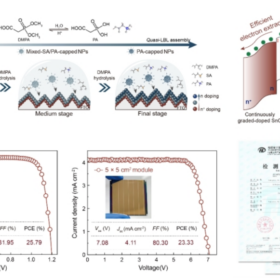
Chinese researchers achieve world-record efficiency of 27.17% for inverted perovskite solar cell
The proposed inverted perovskite solar cell design reduces band misalignment and electron accumulation, suppressing recombination losses and enabling high efficiency in both small-area devices and scalable modules.

World’s smallest island nation advances 18 MW / 40 MWh solar-plus-storage project
In a bid to rid itself of diesel dependence, the world’s smallest island nation of Nauru has signed a landmark memorandum of understanding with Sydney-based Smart Commercial Energy to develop a clean energy solution.

FH Capital to acquire majority stake in JinkoSolar U.S. manufacturing
Private equity firm FH Capital reached an agreement to acquire a 75.1% majority stake in JinkoSolar’s U.S. manufacturing subsidiary to expand domestic module and battery production.

Grid operators may reduce renewables penetration if data center growth continues unchecked, says ENTSO-E
A new report from the European Network of Transmission System Operators for Electricity explores the potential for data centers to become flexible assets in Europe’s electricity system, as well as how to manage grid planning and grid security.

Sunwoda completes large-scale fire test for ‘5 MWh Liquid Cooling ESS’
Sunwoda conducted a large-scale fire test of its 5 MWh liquid-cooled energy storage system, showing contained thermal runaway in one unit without fire spreading to adjacent systems under extreme UL 9540A conditions.

Argentina sees strong growth in solar distributed generation amid electricity price hikes
Argentina’s distributed generation sector is rapidly expanding due to higher electricity tariffs, lower equipment costs, and shorter solar project payback periods of around 3–4 years. Growth has accelerated since 2019, reaching over 4,000 user-generators and 143 MW installed, with strong private-sector-driven adoption.
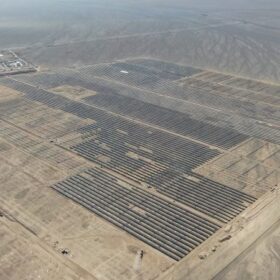
Solar PV accounted for 29% of electricity generation in Chile in March, with instantaneous peaks reaching 75%
The latest bulletin from Generadoras de Chile highlights the continued expansion of BESS systems linked to solar plants, with over 2.5 GW in operation and an additional 6.3 GW under construction, amid rising renewable energy curtailment and transmission grid congestion in southern Chile.
