
Singapore raises 2030 solar target to 3 GW
Singapore has increased its 2030 solar target by 1 GW after surpassing the original 2 GW goal before the end of last year.
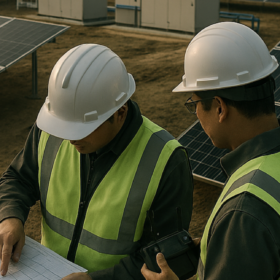
South Korea eases solar siting rules to cut permitting delays for PV projects
South Korea has passed legislative amendments to limit the ability of local authorities to impose separation distances on solar projects, removing a major permitting barrier for PV developers.

Indian renewables gain 8.6 GW of relief after court delays on bird protections
India Ratings and Research said India’s Ministry of New and Renewable Energy (MNRE) will treat commissioning delays linked to Supreme Court proceedings over the Great Indian Bustard as a force majeure-like event, easing liquidated-damages risk for about 8.6 GW of renewable projects.
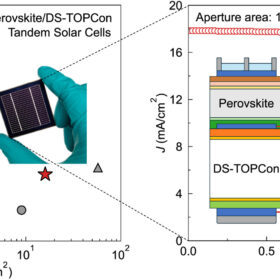
SERIS builds 22.1%-efficient perovskite-silicon tandem solar cell based on double-sided polysilicon layers
SERIS researchers developed a 16-cm² perovskite-silicon tandem solar cell with a double-sided TOPCon bottom cell, enhancing passivation, reducing recombination, and increasing voltage and fill factor.
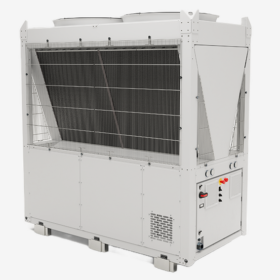
Daikin launches new propane heat pumps for commercial, industrial applications
Daikin has introduced two new propane heat pump lines for industrial and district heating applications, combining monobloc units from 20 kW to 85 kW with modular systems scalable up to 2 MW.
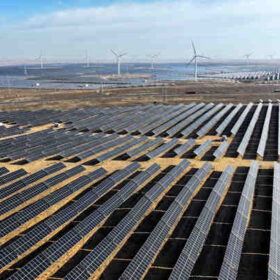
CHN Energy switches on 2 GW solar plant at coal-mining subsidence area
The PV facility transforms a coal-subsidence zone into one of China’s largest utility-scale solar and transmission hubs. It is part of a 6 GW solar cluster, of which 4 GW are now operational.
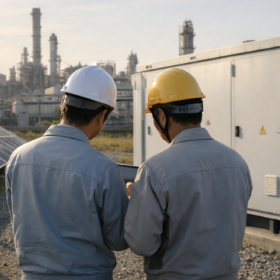
Osaki Electric signs EMS development pact with Kyocera, Taiwan Plastics
Osaki Electric says it has signed an agreement to formalize joint development of its AI-based energy management system (EMS), integrating solar generation and lithium iron phosphate (LFP) battery storage. It aims to sign a final contract by December 2026.

RENA secures 1.2 GW TOPCon equipment order in India
RENA Technologies says it will supply advanced wet chemical processing systems for Celloraa Energy’s 1.2 GW tunnel-oxidized passivated contact (TOPCon) solar cell line in Gujarat, India, with water consumption cut by 50%, H₂O₂-free processes, and start of cell production targeted for the end of fiscal 2026–27.
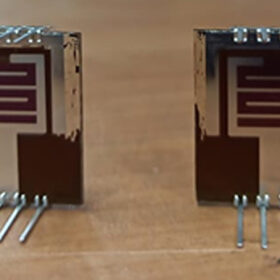
Indian researchers build transparent perovskite-silicon tandem solar cell with 30.2% efficiency
The transparent four-terminal perovskite solar cell employs an ion-modulated spiro-MeOTAD hole transport layer, which passivates interfacial defects, enhances carrier dynamics, and allows for a tunable work function in wide-bandgap perovskites. When integrated into mechanically stacked 4T tandems with an n-TOPCon cell, the device achieved an overall efficiency of 28.4–30.2%, along with improved open-circuit voltage and fill factor.
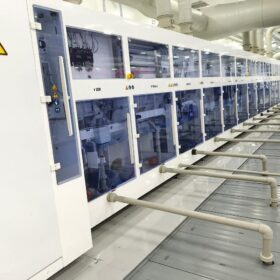
Premier Energies unveils India’s first zero-busbar TOPCon solar cell
Premier Energies Ltd today unveiled India’s first zero-busbar (0BB) TOPCon solar cell at Intersolar India. The 0BB design marks a structural shift from traditional 10BB and 16BB architectures, replacing thick silver busbars with a dense matrix of ultra-fine silver lines to collect current.
