
Early tropical storm cuts solar in Philippines, while East Asia sees La Niña gains
In a new weekly update for pv magazine, Solcast, a DNV company, reports that in January most of East Asia experienced normal to above-average solar irradiance, with southeastern China seeing surges due to reduced clouds and low aerosol levels under lingering La Niña effects. In contrast, the Philippines faced below-average irradiance from early Tropical Storm Nokaen, while other regional cities like Seoul, Tokyo, and Taipei recorded modest gains.

Korean scientists boost performance of tin monosulfide cells with new post-treatment
Researchers in South Korea improved the performance of tin monosulfide (SnS) solar cells with a potassium fluoride-assisted post-treatment and a vapor transport deposition process. The treated solar cells had a power conversion efficiency of 4.10% and reduced recombination sites, compared to 3.42% for untreated devices.
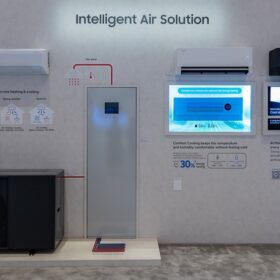
Samsung releases new all-in-one heat pump for residential use
The South Korean giant said its new EHS All-in-One provides air heating and cooling, floor heating, and hot water from a single outdoor unit. It can supply hot water up to 65 C in below-zero weather.

Envision claims AI-enabled storage systems can detect battery safety risks days in advance
Envision Energy has launched a fully integrated energy storage solution combining hardware, software, and market-facing AI to optimize performance, safety, and trading. Its “Physical AI” platform embeds intelligence across cells, systems, and operations, enabling predictive maintenance and real-time market participation.

Korean scientists build mini perovskite solar module with 22.56% efficiency
GIST researchers have developed a perovskite mini-module with 22.56% efficiency by improving the SnO₂ electron transport layer with PEI, reducing defects and electron loss. The module retained 94% of its performance after 500 hours, highlighting potential for scalable, stable perovskite solar cells and modules.

Stäubli invests $10 million to expand PV connector manufacturing in India
Swiss connector manufacturer Stäubli invested $10 million to expand its manufacturing facility in Bengaluru to increase production of PV connectors for domestic and global solar markets.
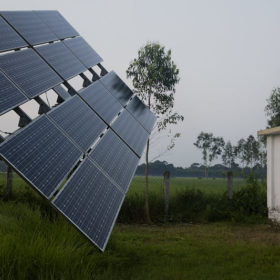
Bangladesh signs PPAs for 523 MW of solar capacity
The Bangladesh Power Development Board (BPDB) has signed power purchase agreements with seven solar projects totaling 523 MW, marking a renewed push for utility-scale solar following the reinstatement of previously canceled approvals.
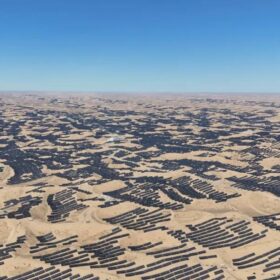
China adds 315 GW of solar in 2025
China installed a record 315 GW (AC) of new solar capacity in 2025, lifting cumulative installed PV capacity to 1.2 TW and pushing non-fossil power sources past thermal generation for the first time.
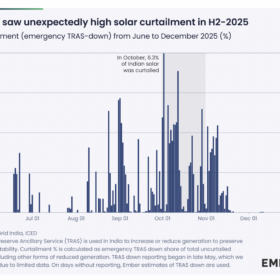
India curtails 2.3 TWh of solar between May and December 2025
A report by energy think tank Ember finds India’s system operator regularly had to curtail solar generation as an emergency measure to maintain grid security, as other resources were already flexing to their maximum capabilities.
Waaree Renewable to acquire 55% of Associated Power Structures
India’s Waaree Renewable Technologies has approved the acquisition of an approximately 55% stake in power transmission and distribution contractor Associated Power Structures Ltd for INR 12.25 billion ($133.6 million), subject to due diligence and closing conditions.
