
Maldives launch tender for 14 MW of solar
The planned capacity is expected to be hybridized with diesel power generators across 14 islands.
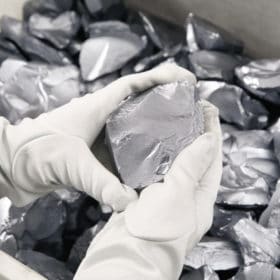
Jinko and JA Solar to invest $100m in 100,000-ton polysilicon fab
The two solar manufacturers will get priority access to polysilicon produced at the planned fab in Inner Mongolia, which developer Xinte Energy has said will be fully operational by June 2023.

Chinese PV Industry Brief: 50 GW wafer factory commissioned in Qinghai province
Furthermore, Zhonghuan Semiconductor has slightly reduced its wafer prices, while Longi has maintained them unchanged. Flat Glass is raising funds to support the construction of a new glass factory with a total annual capacity of 750,000 metric tons.
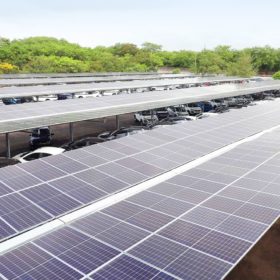
India’s largest solar carport comes online
The 6.2 MWp solar carport at Tata Motors’ manufacturing facility in Maharashtra spans over 30,000 square meters.
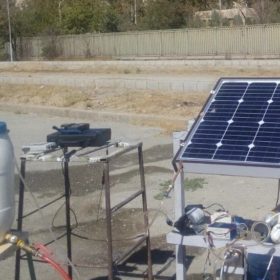
Stand-alone brackish water desalination system powered by photovoltaic-thermal unit
The BWRO unit, which has a treated water production capacity of around 11.80 L/h, was built with a pre-filtration module, a high-pressure DC pump, an RO module, and a post-treatment module. The PVT system was designed to meet the energy requirement of a high-pressure DC pump and a diaphragm-type circulation pump utilized to circulate soft water beneath the PV module for the active cooling of the panel itself.

JinkoSolar, Longi, JA Solar claim 182mm modules offer lowest LCOE for utility scale solar
In a white paper, the three Chinese module manufacturers have reiterated the well-known refrain “bigger is not always better.” Experts from the three companies compared the BoS costs of 182mm-wafer-based modules and 210mm products, and found that the former have a slight advantage in racking, foundation, and land costs.
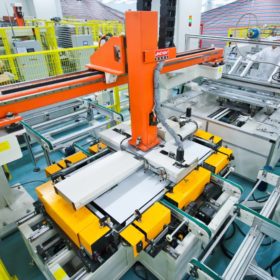
China’s Jinchen holds 10 GW of solar production line orders from India
Jinchen Machinery has landed module production equipment orders from leading Indian solar manufacturers. It has already installed 2 GW of production lines and plans to supply the balance within three months. The company will open an India office in Surat, in the state of Gujarat.
The PV glass price rollercoaster
First-half profits will be up at solar panel glassmaker Xinyi Solar despite the fact the price of the module raw material has been on a downward trend in the current three-month window.

Demand, policies, investment key to green hydrogen development
Ruchi Gupta is a research fellow at the University of Geneva’s Institute for Environmental Sciences. She focuses on how flexibility options, such as sector coupling with hydrogen production, can support renewable energy integration and decarbonize a wide range of sectors.
Module price increases to moderate PV project returns in India
PV module prices have risen by 15% to 20% over the last four to five months. PV modules account for about 50% to 55% of overall project costs, so such price increases could moderate debt service coverage metrics for developers.
