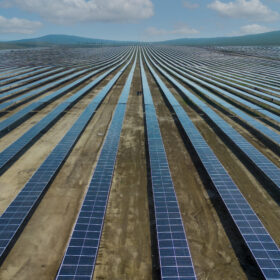
TotalEnergies, Masdar to merge renewables activities in nine Asian countries
The two major developers plan to establish a joint venture company with equal ownership that will be their sole vehicle for building, owning and operating both existing and future solar, storage and wind projects across nine Asian countries.
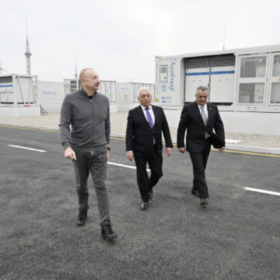
Azerbaijan commissions 500 MWh battery storage project
Azerbaijan President Ilham Aliyev has inaugurated a major battery energy storage system (BESS) project as part of a 500 MWh rollout to strengthen grid stability and support renewable energy integration.

Lithuania’s solar capacity surpasses 3 GW
Lithuania added approximately 600 MW of solar last year, taking total capacity to 3,040 MW. Technical permits have been issued for an additional 4 GW of solar but with grid congestion becoming a primary constraint, future deployments will be increasingly dependent on integration with storage technologies.
European prosecutor investigates suspected solar tender fraud in Slovenia
The European Public Prosecutor’s Office is investigating an unnamed solar company after it breached conditions of a public tender for the co-financing of small solar plants. The office says house searches were carried out this week by Slovenian police, leading to the seizure of documents, electronic data and devices.

Croatia to invest €40 million in household solar, batteries, heat pumps
The Croatian government’s latest set of energy support measures includes new financing for residential solar, batteries and heat pumps, expected to support up to 15,000 applications, as well as an extension of existing electricity price subsidies for homeowners.

Slovakia deploys 243 MW of solar in 2025
Slovakia’s total solar additions last year fall in line with those seen the prior two years, with cumulative capacity now standing in excess of 1.3 GW.
Ukraine prioritizes solar-plus-storage in renewables auctions
Newly-implemented rules governing Ukraine’s energy market introduce solar-plus-storage systems as a separate auction category, ease regulatory barriers governing standalone storage projects and establish processes for renewable energy facilities located in Ukraine’s occupied territories.
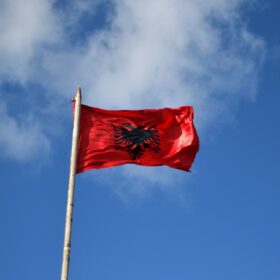
Albania adds over 180 MW of solar in 2025
Albania’s cumulative solar capacity now likely stands between 600 MW and 650 MW, with installations to date led by the utility-scale segment and growing interest from the C&I market.
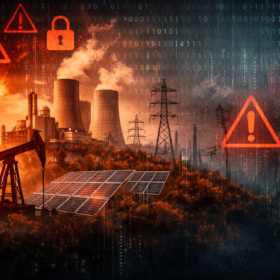
All 2022–2024 cyberattacks on energy infrastructure at a glance
A new global dataset of 119 energy-sector cyber incidents from 2022–2024 shows EU and BRICS countries, followed by the US, are most affected. Attacks targeted power, oil, gas, and nuclear infrastructure, driven by both financial and political motives, with diverse threat actors involved.

Russia adds around 100 MW of solar in 2025
GlobalData says Russia added an estimated 100 MW of solar last year, taking total installed solar to around 3.1 GW. The consultancy is forecasting annual additions of about 200 MW over the next ten years, taking the country’s cumulative solar capacity to 5.3 GW by 2035.
