US-backed Econergy secures financing for 92 MW solar farm in Romania
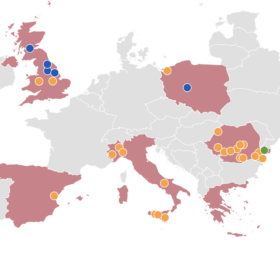
Econergy Renewable Energy has secured financing from Raiffeisen Bank for its 92 MW Parau solar project in Romania, marking the Israeli company’s second such transaction with the bank.
Polish capacity market auction for 2029 catalyzes gigawatts of battery storage
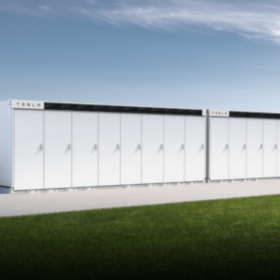
The much-anticipated capacity market auction for 2029 conducted by Polskie Sieci Elektroenergetyczne (PSE) ended in the seventh round with a price of PLN 264.90 ($62.12)/kW per year. Such a clearing price rendered gas projects uneconomical and left significant room for battery storage systems to secure contracts.
Romania allocates 432 MW of PV at average price of €0.051/kWh in first renewables auction
The Romanian authorities have allocated 1.52 GW of renewable energy capacity in a procurement exercise, with the lowest bid for PV technology at €0.045 ($0.047)/kWh.

Montenegro to launch 300 MWh battery storage tender
Montenegro’s Elektroprivreda Crne Gore (EPCG) has upped the ante for its first battery energy storage tender.
Midea Hiconics releases new residential all-in-one battery storage systems
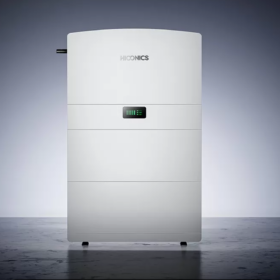
The Chinese company says its three-phase Hienergy series can pair with PV arrays of up to 8.5 kW, with battery storage reaching up to 40.8 kWh.

Czech parliament backs plan to retroactively cut solar feed-in-tariffs
The Czech lower house of parliament has approved plans to retroactively cut feed-in-tariffs (FIT) for solar projects built between 2009 and 2010. The local solar sector has continued to criticize the planned law changes, which still need approval from the upper house.
Nord/LB to invest €73 million in 100 MW Polish solar farm
Renewables developer OX2 has secured a €73 million ($76.8 million) financing package from bank Nord/LB for a 100 MW solar farm currently under development in southwestern Poland.
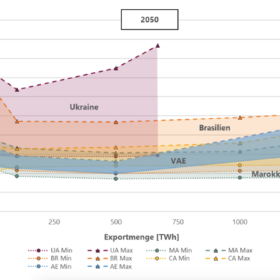
Global hydrogen atlas shows potential import countries for Germany
Researchers from the Fraunhofer Institute for Solar Energy Systems have analyzed the techno-economic potential of importing hydrogen to Germany from Brazil, Morocco, Canada, Ukraine and the United Arab Emirates.

Czech electricity grid to get €400 million upgrade
The European Investment Bank (EIB) has granted a €400 million ($420 million) loan to Czech utility ČEZ to upgrade and expand Czechia’s electricity distribution grid. The upgrades are expected to help absorb up to 5.5 GW of new renewable capacity.
Bulgaria allocates 3 GW of renewables capacity, 1.17 GW of storage in auction
The Bulgarian authorities awarded BGN 526 million ($284 million) to 397 renewable energy projects in the country’s latest procurement exercise.
