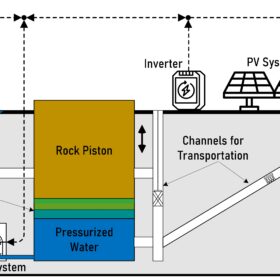
PV-driven hydraulic hydro storage may hit $0.022/kWh LCOE in the U.S.
An international study has demonstrated that utility-scale solar PV paired with hydraulic hydro storage (HHS) could reach an LCOE as low as $0.022/kWh in select U.S. regions. The system could provide GWh-scale, cost-competitive, and highly reliable long-duration storage, capable of powering large commercial districts with minimal environmental impact.

Egypt tenders 500 MW solar project
Egyptian Electricity Transmission Co. (EETC) has launched an international tender for a 500 MW solar project in Egypt’s West Nile region. The deadline to submit prequalification documents is May 11.
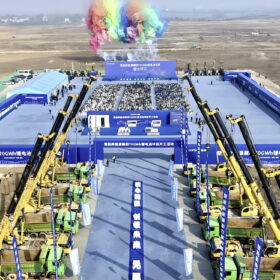
Cornex secures 11.5 GWh of battery orders from Saudi Arabia, Egypt
The Chinese manufacturer will supply 5.5 GWh of energy storage products to Saudi Arabia and another 6 GWh to Egypt, as it works to expand its global footprint.

GCL, Cornex, TBEA to build solar manufacturing complex in Egypt
Egypt’s Kemet has signed three agreements with Chinese companies over the last week, covering plans for a 5 GW solar cell complex, a 5 GWh battery energy storage factory and Egypt’s first solar inverter factory.

The Hydrogen Stream: Scatec-led 100-MW green project in Egypt to step operations in the coming months
The consortium expects to reach Final Investment Decision (FID) on the full-scale project in the Ain Sokhna Industrial Zone in the coming months, while Brazil’s Federal Court provisionally ordered the suspension of construction activities of Solatio’s project in the State of Piauí.
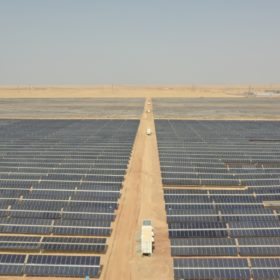
Scatec secures PPA for Africa’s largest solar-plus-storage project
Scatec has inked a 25-year power purchase agreement in Egypt for a 1.95 GW solar, 3.9 GWh battery energy storage project, representing the developer’s largest investment to date.
Amea Power begins construction on 1 GW/600 MWh solar-plus-storage plant in Egypt
According to the developers, the $700 million giant project will be Africa’s largest single-site hybrid renewable facility. Amea Power began construction before financing was completed.
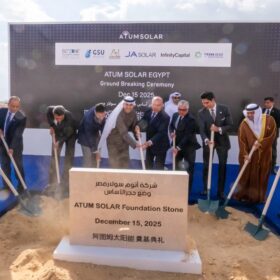
JA Solar joins consortium building $210 million PV module factory in Egypt
The 200 square meter facility is targeting an annual manufacturing capacity of 2 GW of solar cells and 2 GW of solar modules. The solar cell production will be 100% for export.
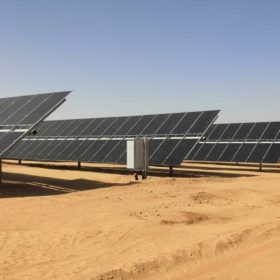
EDF Power Solutions to take 20% stake in Scatec solar-storage project in Egypt
Oslo-based Scatec ASA says it will retain majority ownership in Egypt’s 1.1 GW solar and 100 MW/200 MWh Obelisk project, with EDF Power Solutions taking 20% and Norfund 25%.
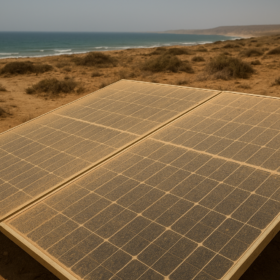
The impact of dust on PV systems in arid coastal environments
A Saudi–Egyptian research team investigated the effects of four types of dust on photovoltaic panels in arid coastal environments, finding that power losses can reach up to 48%.
