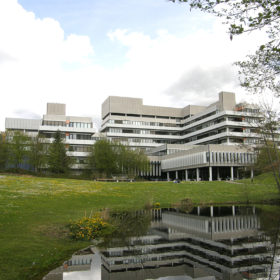
European researchers discover new effect of light on perovskites
Scientists led by Germany’s Max Planck Institute for Solid State Research have demonstrated for the first time that, as well as electrons, light also releases charged particles in a perovskite solar cell material. The researchers state that this groundbreaking discovery could make possible new solar power applications, such as batteries directly charged by light.
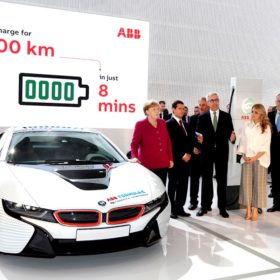
ABB launches what it says is world’s fastest EV charger
The Terra High Power charger can charge an electric vehicle (EV) in just eight minutes, thus adding up to 200 km of range, says ABB, which launched the new model at this year’s Hannover Messe.
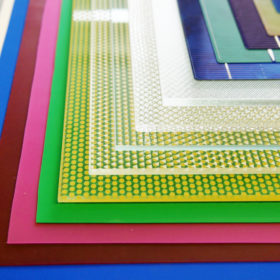
Fraunhofer ISE, Schmid develop production line concept for custom design modules
German research institute, the Fraunhofer Institute for Solar Energy Systems (ISE) and equipment supplier, Schmid have jointly developed a production line for customizable modules for building-integrated projects. According to Fraunhofer ISE, the concepts developed by joint study could reduce the production cost for BIPV modules as much as 35%.

Wind has no chance against PV in Germany’s mixed wind-solar auction
32 to 0 for solar PV – that’s the result of the first technology-neutral tender. The average final price of €0.0467 per kWh was slightly above the solar-only-tender held in February.

SolarWorld keeps shipping modules
Production is ongoing, despite the solar PV manufacturer’s recently announced insolvency proceedings. Starting this week, solar modules will be delivered to customers in France, Kuwait, Japan, Sri Lanka and Germany. SolarWorld is also seeking new investors.
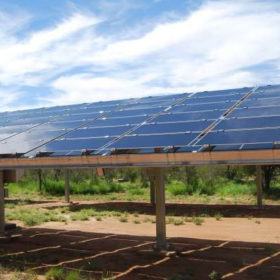
Calyxo files for insolvency
The German thin film solar PV module maker was forced to start the proceedings after an order from a major customer was canceled.
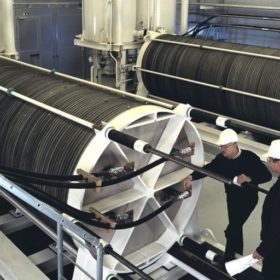
Hydrogen, don’t give up!
For decades, hydrogen has been sold to us as the energy carrier of the future. You might not want to hear it anymore, because the future never seems to start. But times will change as recent developments in Germany indicate, writes Berlin-based renewable energy consultant, Stephan Franz.
The impact of transition
The smarter E: First to join Intersolar was the energy storage trade fair EES, and now the concept has become even more comprehensive, the trade fair and conference even bigger. Markus Elsässer, CEO of the organizer Solar Promotion, explains that all of the events now fall under the umbrella of “The smarter E”.
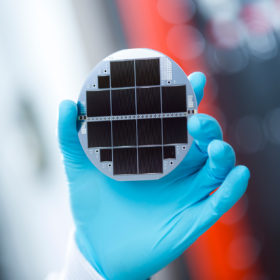
Fraunhofer ISE announces 33% efficiency for multi-junction solar cell
Together with Austrian equipment manufacturer EVG, Fraunhofer ISE has achieved an efficiency of 33.3% on a multi-junction solar cell. The highlight of the cell is the ultra-thin II-V semiconductor layer. However, it will be a few years before mass production is possible.
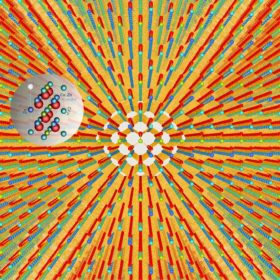
German scientists use germanium to improve performance of kesterite solar cells
Although current efficiencies for solar cells based on kesterite do not exceed 12.6%, the use of germanium may enable the development of cells with a higher energy band gap.
