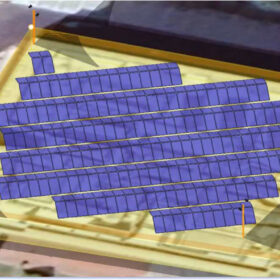
New direct lightning protection design for east-west rooftop PV systems
Scientists in the Emirates have developed a novel lightning mast layout that reportedly eliminates shading effect on PV panels. The proposed approach also addresses earth grid requirements under varying moisture conditions.
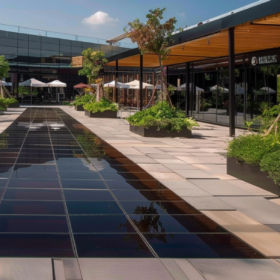
Solar PV flooring for residential, commercial use
Turkey-based Ankara Solar Energy launched its own brand of walkable PV flooring for residential and commercial projects. Its 30 W and 120 W square panels with anti-slip glass front covers are sold with a supportive pedestal system, and are now available for the European and U.S. markets.

Israel presents 2050 net-zero roadmap envisaging up to 77% solar share
The Israeli Ministry of Energy and Infrastructure has presented three scenarios for its 2050 green goals, changing in accordance with developments in solar, hydrogen, and nuclear power production. In the most solar-focused scenario, the country would have a PV capacity of 108 GW.
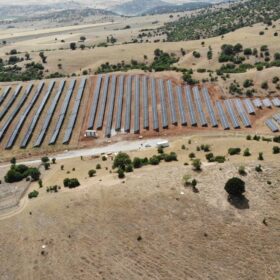
TUI powers hotels with solar plants in Turkey
Travel and tourism company TUI recently started operating three new solar plants in Turkey, totalling 15 MW, to supply power to eight hotels. It plans to power more hotels in the country with additional solar plants.
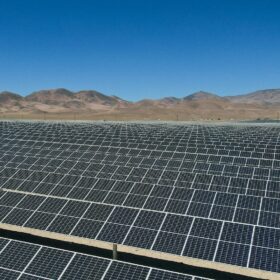
China’s CEEC wins 2 GW solar project in Saudi Arabia
China Energy Engineering Corp. (CEEC), via its subsidiaries, has signed an engineering, procurement and construction (EPC) contract for a 2 GW solar installation in Saudi Arabia. It will handle the project in collaboration with a project company established by ACWA Power Company.
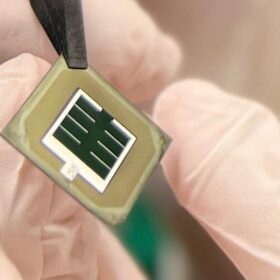
KAUST reveals details of 33.7%-efficient perovskite-silicon tandem solar cell
In a new scientific paper, researchers from the King Abdullah University of Science and Technology (KAUST) in Saudi Arabia presented the 33.7%-efficient perovskite-silicon tandem solar cell announced in May last year. They explained the device is based on a perovskite additive known as tetrahydrotriazinium that reportedly enhances the phase stability of the perovskite film under heat and light conditions.
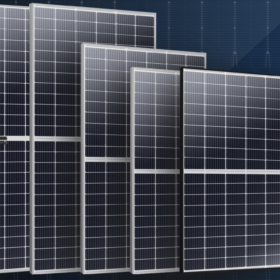
Sinovoltaics updates map of European solar module manufacturing sites
The latest report on the supply chain for European PV module production provides the status of 121 solar manufacturing sites, including closures and capacity on hold. It maps plants that produce PV modules, cells, wafers, ingots, polysilicon, and metallurgical-grade silicon.
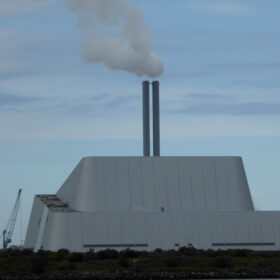
Coupling photovoltaics with waste-to-energy
Researchers have simulated the addition of PV plants and waste-to-energy systems in the Iraqi Al-Gharab region, that suffers from power cuts, and have identified the optimal size and locations for these hybrid plants, with the LCOE dropping by 7.7%.

Israel mandates rooftop solar on new big buildings, targets 3.5 GW by 2040
The Israeli authorities have introduced new regulations requiring rooftop PV on new large buildings, with plans to install 3.5 GW by 2040. The minimum production capacity has been set at 5 kW.
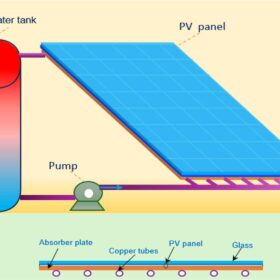
Hydronic closed-loop cooling system for photovoltaic modules
An international research team has developed a closed-loop PV cooling system that can reportedly offer 24-hour continuous operation. The system is claimed to be particularly suitable for hot and arid regions and to improve the lifespan of solar panels by up to 8.2%.
