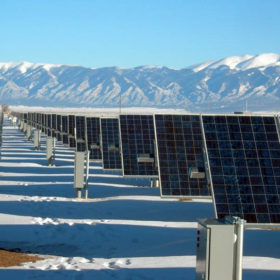
PV in the Circular Economy: Modeling tool helps predict flow of solar materials
PV ICE uses the latest data from the solar industry to model the flow of PV materials over the next several decades, helping to predict the effects of different market trends, technological developments, and government policies.

Ontario amends net metering policy to allow third-party ownership
Prior to these amendments, Ontario’s net metering regulation required the customer to own or operate the renewable generation system to qualify as an eligible generator.
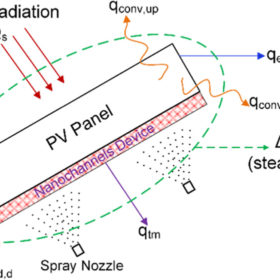
New solar module cooling tech based on porous nanochannels
US scientists have utilized a nanochannels device to cool down the operating temperature of a commercial PV module and have found that the proposed technique is able to improve power yield by up to 32.8%. Spray droplets are dispersed over the nanochannels device in order to eliminate the need for a continuous supply of a coolant.
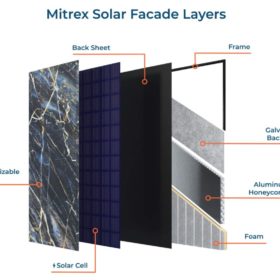
Canadian university to be equipped with a stealthy solar façade/microgrid
Building-integrated photovoltaics provider Mitrex said its system will provide St. Mary’s University student residence with a power-producing microgrid.
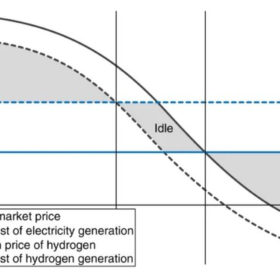
Reversible fuel cells for backup power generation
Reversible fuel cell systems based on solid oxide cell (SOC) technology may become an efficient tool to cope with price volatility in the energy market, according to new research from Stanford. Through the proposed model, which mainly considered the electricity markets in Germany and Texas, the research group found that the reversible system may be competitive at current hydrogen prices, provided that there is sufficient variation in daily electricity prices.
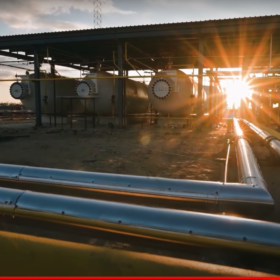
Green ammonia low-hanging fruit for India’s hydrogen economy
A new report from IEEFA says green ammonia could help India significantly reduce its trillion-rupee fertilizer subsidy bill and cut dependence on liquefied natural gas (LNG) imports for fertilizer production.

Zinc-ion battery for residential applications
Developed by Canadian start-up Salient Energy, the zinc-ion battery has a rated capacity of 60 Ah, a nominal voltage of 1.3 V, and a volumetric energy density of 100 Wh/L. The device measures 26cmx24cmx1.2cm and weighs in at 1.3 kg
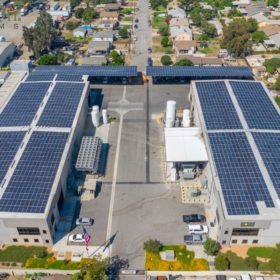
Three-year commercial PV payback expected via roof mount cost reductions
Solar Atmospheres says a 772 kW PV solar array, installed on S-5! metal roofing mounts, and a 1,561 kW/3,122 kWh Tesla battery storage system will help it to meet its varying energy demands.
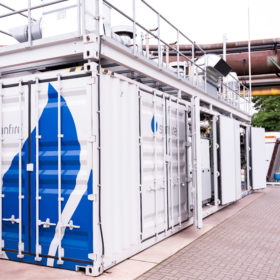
The Hydrogen Stream: Salzgitter claims record efficiency for largest high-temperature electrolyzer
Salzgitter has claimed a record efficiency level for its EU-funded GrInHy2.0 hydrogen project, which is based on solid oxide electrolysis cell tech. The high-temperature electrolyzer uses waste heat from the company’s steel production processes.
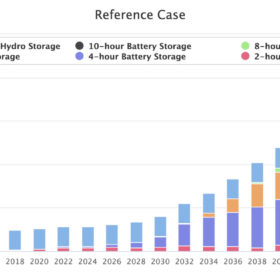
NREL’s storage projections for 2050
The National Renewable Energy Laboratory’s (NREL) final report on the future of storage presents “key learnings” from a series of six in-depth studies.
