
Masdar and EDF’s Emerge signs long-term solar deal with Saudi’s Misk City
Emerge, a joint venture between Masdar and EDF power renewables, will develop and deliver a 621 kWp rooftop solar plant on a dedicated carport structure and other assets within Misk City as part of a 20-year agreement.

Saudi Arabia signs 5 solar PPAs totaling 12 GW
Saudi Arabia has inked five solar power purchase agreements (PPAs) with a developer consortia led by ACWA Power covering 12 GW of new capacity. Alongside two wind PPAs totaling 3 GW, the seven projects have been billed as the largest renewable energy capacity signed for in a single phase globally.
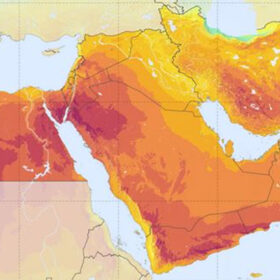
New method for PV site suitability mapping
Scientists in Malaysia have developed a novel deep-learning method for PV suitability mapping. Applying the new approach to the Middle East, they found that approximately 5.8% of the region has very high suitability and 11.5% is highly suitable for PV energy development.
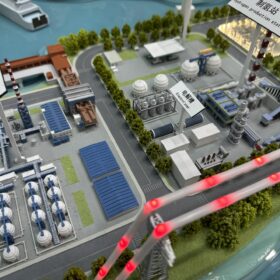
Solar hydrogen could be produced at 4.23$/kg in Saudi Arabia
New research from Saudi Arabia shows that PV, concentrated solar power (CSP), or hybrid PV-CSP systems could significantly reduce the levelized cost of hydrogen. CSP offers higher capacity factors, but PV-driven electrolysis provides the lowest projected cost for hydrogen production.
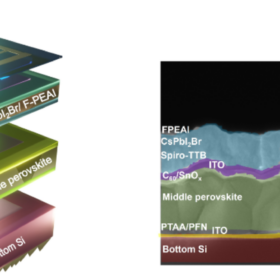
Fraunhofer ISE tests cesium lead perovskite in perovskite-perovskite-silicon triple junction solar cell
Fabricated via thermal evaporation, the champion perovskite-perovskite-silicon triple-junction solar cell reached an efficiency of around 22% after 110 hours of fixed-voltage operation under ambient conditions without encapsulation.

Novel MPPT technique uses fuzzy logic control with new inputs
Academics have developed a maximum power point tracking (MPPT) algorithm for PV systems that combines incremental conductance with fuzzy logic control. The inputs used are the sum of conductance and incremental conductance and its rate of change. It had an average efficiency of 97.7%.
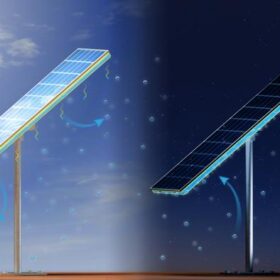
New cooling gel could raise PV module efficiency by 12%
Researchers in Saudi Arabia have developed a hydrogel composite that absorbs moisture in solar modules overnight and facilitates evaporative cooling throughout daylight hours. The system has undergone lab tests and outdoor experiments on two continents.

Perovskite-silicon tandem solar cell built with hybrid blade coating achieves 27.8% efficiency
The King Abdullah University of Science and Technology and the Fraunhofer Institute for Solar Energy Systems report producing perovskite-silicon tandem solar cells with open-circuit voltages exceeding 1.9 V as the result of a two-step hybrid evaporated/blade-coated process for perovskite films.
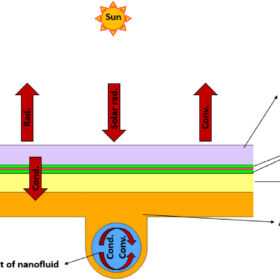
Scientists build photovoltaic-thermal panel hosting four different cooling techs
Researchers from the Middle East have simulated a novel PV thermal module which includes a thermoelectric generator above the absorber layer, conical helical tape in the cooling tube and a ferrofluid. These technologies reportedly contributed to increased PV efficiency and thermal efficiency by 2.12% and 23.34%, respectively.
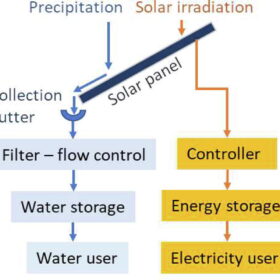
How to combine photovoltaics with rainwater harvesting
Scientists have developed a system that harvests rainwater running off PV panels for household use or hydrogen production. Their analysis showed that, in the southern Sahel, the system can meet both the energy and water requirements for electrolysis, with surplus rainwater covering up to 50% of a household’s daily water demand.
