
Distributed solar as an antidote to illegal roof dwellings
Researchers in Taiwan are proposing a market-based incentive scheme to help property owners to move from using their roofs for illegal dwellings to rooftop solar power generation. They found these owners should be rewarded for solar power generation but also be compensated for the income loss due to the removal of illegal rentals.
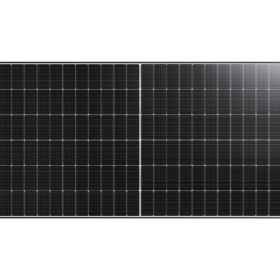
Winaico releases 525 W TOPCon solar panels
Taiwanese manufacturer Winaico has developed new 525 W TOPCon solar panels with a power conversion efficiency of 22.1% and a temperature coefficient of -0.30% per degree Celsius.
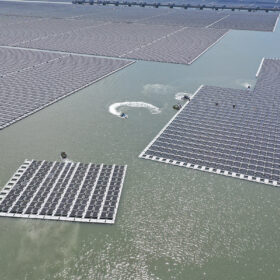
Ciel & Terre hits 1.5 GW floating PV pipeline
French floating PV specialist Ciel & Terre says it now has more than 1.5 GW of floating PV projects in the design phase or under construction. It has already completed 280 floating solar projects in more than 30 countries, totaling 820 MW.
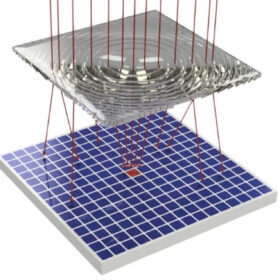
Taiwanese scientists develop high-concentration PV system
Taiwanese researchers have developed a system featuring a 2 × 2 Fresnel lens array and a solar panel made of III-V materials and polycrystalline solar cells, with low light leakage.

AUO, SAS join forces to strengthen Taiwan’s PV industry
Taiwanese manufacturers Sino-American Silicon (SAS) and AUO Corp. have announced a long-term supply deal for M10 solar cells.

High-capacity energy storage based on affordable, eco-friendly materials
Worldwide Universities Network researchers used cheap and abundant starting materials to synthesize a small molecule organic electrode material and achieved a considerable performance boost with various battery chemistries. The new cathode material exhibited unparalleled cycling stability, ultra-high capacity, and rate capability in aqueous zinc-ion batteries.
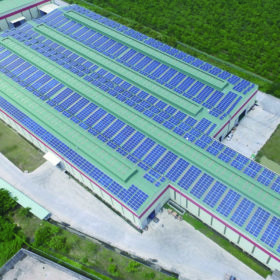
Taiwan maintains FIT rates for PV
The Taiwanese authorities have decided, once again, not to reduce feed-in tariff (FIT) rates for PV, as initially planned, in order to support more solar deployment.
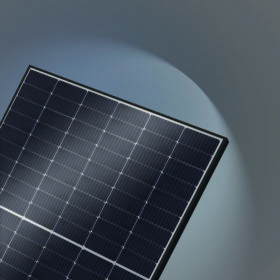
Winaico unveils new 410 W solar modules
Winaico’s new PV modules are based on monocrystalline half-cells and a 10-busbar design, with a power conversion efficiency of 21.0%.

Taiwanese consortium develops easily recyclable solar module
The Industrial Technology Research Institute (ITRI) and United Renewable Energy (URE) have developed a solar panel that can be easily dismantled to simplify the recycling process. They claim that 96% of the materials in the panel can be recovered, including all of the solar cells and front glass.
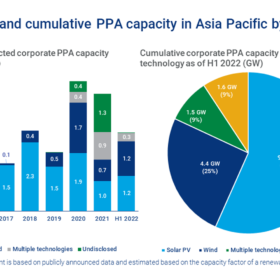
Solar dominates renewable corporate PPAs in Asia Pacific, says WoodMac
Corporations in the Asia-Pacific region are set to contract a record 7 GW of renewable capacity in 2022, according to a new report by Wood Mackenzie. Solar accounts for 57% of the region’s contracted corporate renewable power purchase agreements (PPAs) to date. India, Australia and Taiwan account for 89% of overall capacity in the region.
