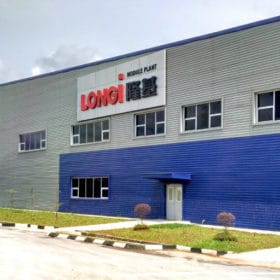
Longi Solar signs 200 MWp mono PERC supply deal in Vietnam
The Chinese solar manufacturing giant will supply its latest modules to Singapore-based PV developer Hexagon Peak for a utility scale pipeline in Vietnam.

Emerging markets help new faces into list of world’s top EPC providers
Although the Wiki-solar website ranking only gives a snapshot of PV project engineering, procurement and construction contracts outside China, it is nevertheless a useful indicator of the changing shape of the global solar market.
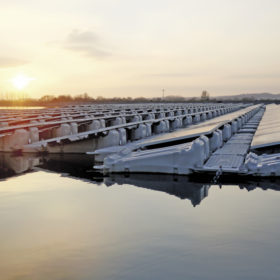
Vietnamese hydropower company secures financing for 47 MW floating PV project
Da Mi has $37 million for a floating solar project it wants to build at its hydropower plant in Binh Thuan province. If built before 2022, the project will be entitled to a feed-in tariff of $0.0769/kWh – provided a draft FIT scheme being considered by the government is passed into law.
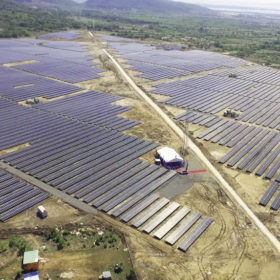
Vietnam may cut FITs for large scale solar 20%
The tariff for rooftop PV will be maintained at $0.0935/kWh but payments for ground-mounted and floating solar could be cut to $0.0709/kWh and $0.0769, respectively. The previous FIT scheme, according to government figures, has driven the deployment of around 5 GW of solar generation capacity.
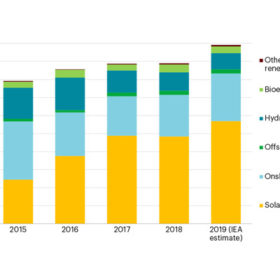
International Energy Agency forecasts 115 GW of new solar this year
The global expansion of PV, wind power and other clean energies will see double-digit growth this year as solar continues to lead the pack.

Shrimp and PV goes together like peas and carrots
With the benefits solar panels can bring to cropland being considered in Europe, PV and aquaculture are working in tandem in Vietnam. Shrimp and fish farming requires land and lots of water but solar panels are helping mitigate those demands.

Longi signs $540m wafer supply deal
The contract figure is based on today’s mono prices and equates to almost 20% of the revenues seen in 2018. The supply deal is the second big order the company has secured in 12 months.
Vietnam’s 2019 commissioning rush
Vietnam had already successfully commissioned 1.5 GW of utility-scale PV at the end of May this year, and there is no sign of this slowing down, with another 2 GW teed up for June 2019. The breakneck speed in development is making Vietnam a powerhouse in the region in installed capacity, even nipping at the heels of Australia. Rystad Energy’s Minh Koi Le looks at the state of play in the Vietnamese solar market.

Renewables generation cheaper than coal for many power companies – but not yet for Eskom
An investor tool examining the coal fleets of major global power companies has offered up analysis which flies in the face of arguments solar and wind generation could help turn around the debt-saddled South African utility.
‘True grid parity about more than electricity price’
The head of Mercom Capital says solar has a long way to go before it can stand without policy support. Effective grid parity will only be achieved when the cost of PV electricity factors in the expense of grid upgrades and the storage systems its intermittent nature requires, says Raj Prabhu.
