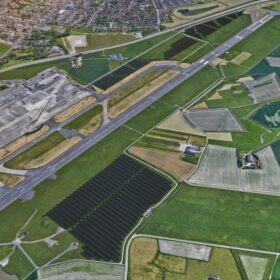
Ostend-Bruges Airport to host Belgium’s second-largest solar plant
EnergyVision, a Belgian developer, has revealed plans to build a €35 million ($37.9 million), 40 MW PV facility for Ostend-Bruges Airport. The project will involve 66,200 solar modules, each with outputs of 605 W. Construction is set to begin in September.

Netherlands allocates 1.9 GW of PV in 2022 SDE++ round
Rijksdienst voor Ondernemend Nederland (RVO), the Dutch state-run agency that manages the SDE++ program, said that its latest tender round has allocated 1.051 MW of PV capacity for commercial and industrial solar systems, along with 862 MW for utility-scale PV plants to be constructed on land or water.

Field test supports viability of 20% hydrogen in German gas network
TÜV Rheinland, Rheinische Netzgesellschaft, and GVG Rhein-Erft have supplied 100 households in Erftstadt, Germany, with gas mixed with 20% hydrogen. They have found there were no disruptions to systems, devices, or the network itself.

New platform to purchase and sell PV, wind projects in Spain
NTeaser is a new platform that connects developers and investors to sell renewable energy projects and assets without intermediaries.
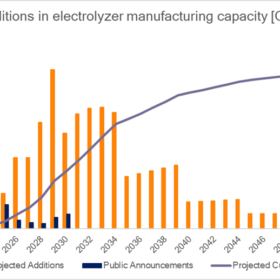
The Hydrogen Stream: Green hydrogen market could hit $850 billion in 2050
Research outfit Rethink Energy says the green hydrogen market could reach $850 billion in value by 2050.
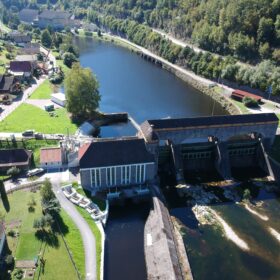
EnBW builds pumped hydro storage facility in Germany
German power utility EnBW says its new pumped hydro storage project will require an investment of €280 million ($304.9 million). It is scheduled for completion by the end of 2027.
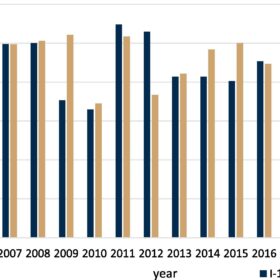
Researchers assess degradation in PV systems older than 15 years
Scientists have used the US National Renewable Energy Laboratory’s (NREL) HOMER software to calculate the degradation of solar panels deployed in two rooftop PV systems operating in Germany since 2003. Their calculations focused on the energy productivity of the systems.

Ideal unveils monobloc heat pump for residential applications
UK-based Ideal Heating has developed an air-source heat pump for the UK residential market. It is available in two versions with a heating output of 8.2 kW or 10.3 kW and uses R32 as the refrigerant. It says the heat pump can be paired with rooftop solar to maximize self-consumption.

French startup plans 5 GW solar module factory
Holosolis aims to construct a new factory in Hambach, northwestern France, close to where REC previously had plans for a 4 GW heterojunction panel manufacturing facility.
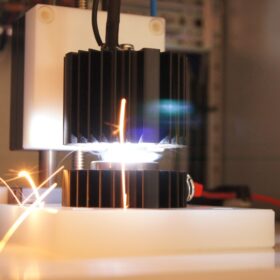
Fraunhofer ISE proposes new standard for inverters with arc fault detectors
The Fraunhofer Institute for Solar Energy Systems (ISE) has replaced the 2011 UL 1699B standard with its new IEC 63027 standard for inverters, incorporating arc fault detectors. The objective is to improve safety and efficiency in inverter technology.
