
Spanish PPAs and the remuneration reduction under RDL 17/2021
The temporary measures enacted by the Spanish government in mid-September to reduce the price of electricity affect many owners of wind and solar power plants on the Spanish mainland to varying degrees.
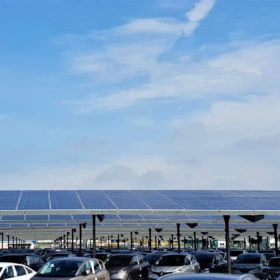
More details on France’s new FIT for PV projects up to 500 kW
The provisions for a fixed feed-in tariff (FIT) for all PV systems up to 500 kW in size have finally been published in France’s Official Journal – after an agonizing two year wait. pv magazine France provides the low down on tariffs, caps, carbon criteria, and integration.
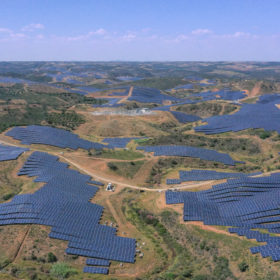
Portugal completes 219 MW unsubsidized PV project
Ireland-based WElink Group and China Triumph International Engineering Co. Ltd have announced the completion of the 219 MW Solara 4 project in Portugal’s Algarve region. An inauguration ceremony for the project was held last week, and it is expected to begin full operations before the end of October.

Reliance Industries acquires 100% stake in REC Group, plans new manufacturing bases
India headquartered multinational Reliance Industries, through its subsidiary Reliance New Energy Solar Limited, yesterday announced the acquisition of Norway headquartered module manufacturer REC Group. The move comes as Reliance pushes forward with its US$10 billion plan to move in on the renewable energy industry, having also this week announced acquisition of a 40% share in EPC provider Sterling & Wilson.
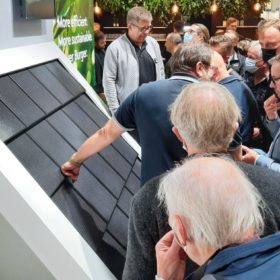
Meyer Burger unveils new solar tiles
Meyer Burger plans to start selling a new building-integrated PV product from 2022. It says the solar tiles have a high energy yield, with simplified installation and the ability to also provide heating. German engineering company paXos designed the tiles.
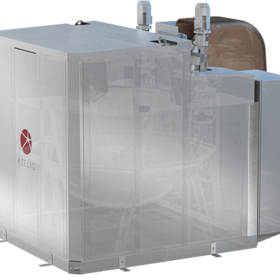
Azelio launches electro-thermal storage system for commercial applications
Developed by Swedish manufacturer Azelio, the system stores renewable energy in recycled aluminum and has an electrical and thermal energy output, with a total efficiency of 90 %. One unit’s storage capacity reaches 165 kWh of electrical output and on top of that thermal energy between 55-65 degrees Celsius. Its modular configuration allows the deployment of projects with a capacity of up to 100 MW.
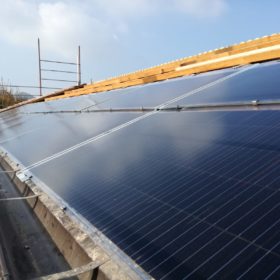
Solar tiles for roof coatings, shelters, facades
Italian startup EnergyGlass has developed a solar tile with 4 mm double-laminated safety glass. It is available in black, white and colored versions and has power outputs ranging from 120 W to 290 W. The tiles can be used to replace conventional roofs or they can be integrated into existing rooftops.
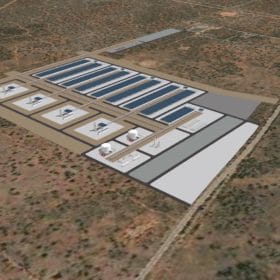
RWE signs deal with Greek utility aiming for 2 GW of coal-mine solar
It’s official. After 18 months or so of negotiations, electric companies in Germany and Greece last night inked a deal to confirm RWE’s entry into the Greek power market. Initially, the arrangement concerns 2 GW of new PV generation capacity to be built in former lignite mines, however the deal may later expand to include additional power projects.

French consortium develops bio-based PV modules
Roctool, a French production equipment supplier, has teamed up with the CEA-Liten research institute to develop 300 mm x 300 mm solar modules based on recycled, bio-based materials via a novel manufacturing process. The first prototypes will be unveiled over the next few months.
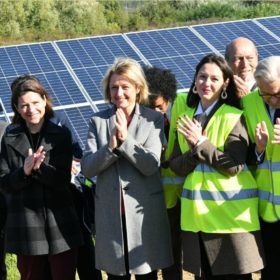
French government confirms FIT of €0.098/kWh for PV systems up to 500 kW
PV project developers can secure France’s feed-in tariff without participating in tenders.
