
Solar module prices unaffected by tariff chaos
Martin Schachinger, founder of pvXchange.com, says the European PV market has remained unaffected by the disruptive effects of the Trump administration’s new tariff policy.
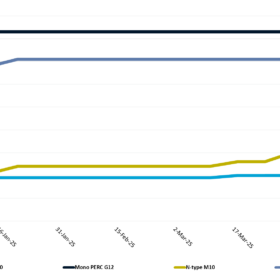
Solar wafer price outlook turns pessimistic, global flows shift with evolving trade policies
In a new weekly update for pv magazine, OPIS, a Dow Jones company, provides a quick look at the main price trends in the global PV industry.

UL battery safety standard updated for new storage chemistries
Underwriters Laboratories (UL) says the fifth edition of its ANSI/CAN/UL 9540A standard addresses technology such as sodium-ion batteries and new use-cases including rooftop installations.

Average silver price up 21% in 2024, says Silver Institute
Demand for silver in the PV industry hit 197.6 million ounces in 2024, according to a new report from the Silver Institute. It says the average silver price stood at $28.27 per troy ounce last year, up from $23.35 in 2023.
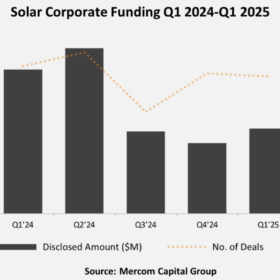
Global corporate solar funding falls 41% to $4.8 billion in Q1 2025
Corporate funding in solar fell considerably in the first three months of this year due to policy reversals, tariff shocks and regulatory uncertainties, says a report from Mercom Capital.

Fire risks in industrial rooftop solar systems due to poor installation
Clean Energy Associates (CEA) has inspected more than 600 industrial PV systems and has found widespread safety risks, largely stemming from poor installation practices, but many issues are easily identifiable and fixable.
Global solar module shipments hit 703 GW in 2024
The new edition of the International Technology Roadmap for Photovoltaic (ITRPV), published this week, reports that average PV module prices last year dropped by 33% compared to the end of 2023.

Who are the solar and wind champions?
In a new monthly column for pv magazine, the International Solar Energy Society (ISES) reveals that Sweden, Australia, Netherlands, Germany and Denmark are the leading countries for per capita solar and wind generation capacity. Furthermore, it explains that global solar capacity has been doubling every 3 years, and wind every 6 years, whereas fossil and nuclear capacity and generation have been almost static in recent years.

Glint Solar unveils software for early-stage BESS projects
The Norwegian PV planning software company has released a new product for prospecting, analysis, and design of battery energy storage system (BESS) projects at the early stage.
IEA’s World Energy Outlook systemically underestimates solar PV development
Since 1993, the World Energy Outlook (WEO) of the International Energy Agency (IEA) has been an authoritative report on energy statistics and guiding future energy supply and demand developments. An examination of these reports, however, indicates that even the most progressive of WEO scenarios has vastly underestimated the growth of renewable energy technologies, especially solar PV.
