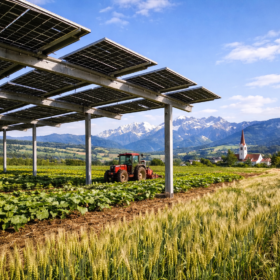
Austria could harness 90 TWh of agrivoltaics using 5–16% of cropland
Austrian researchers conducted a techno-economic analysis of agrivoltaic systems and found that 5%–16% of the country’s cropland would be required to meet its solar electricity targets.

Japan establishes national benchmarks for agrivoltaics as sites expand
The Japanese government has defined new standards for agrivoltaics as regulators begin tightening oversight in response to nearly one-quarter of projects reporting reduced crop yields or sub-standard cultivation beneath solar panels.
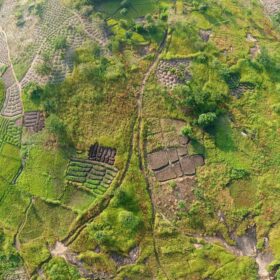
Africa’s next growth frontier: Why agrivoltaics are worth the long-term bet
Africa has abundant sunlight, arable land, and innovative farmers, and agrivoltaics offers a long-term strategy to boost food security, climate resilience, and energy access simultaneously. Success depends on coordinated policy, inclusive community engagement, and patient, innovative finance to build a viable, scalable market.
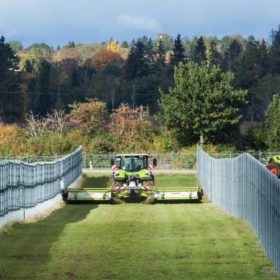
Greece to open applications for 130 MW agrivoltaics plan
Greece’s distribution grid operator will begin accepting applications for agrivoltaic systems on March 4, marking the first step in implementing a new law targeting 130 MW of capacity nationwide.
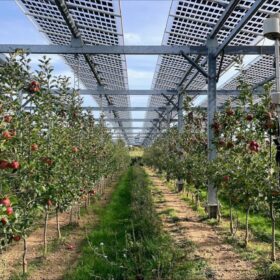
New solar tracking strategies aim to maximize crop yield in agrivoltaics
Swedish researchers developed two novel single-axis solar tracking strategies that dynamically adjust panel tilt based on crop light requirements, balancing photosynthesis and energy production. One strategy prioritizes daily light integral targets before shifting to energy capture, while the other uses the light-response curve to optimize photosynthesis, offering improved dual-use efficiency compared with conventional tracking methods.
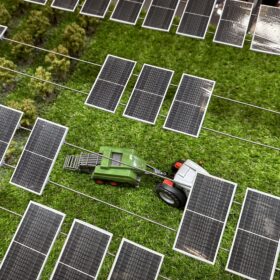
Survey finds 85.8% of Canadians support agrivoltaics
Canadian researchers conducted the first nationwide survey on public attitudes toward agrivoltaics, finding strong support across provinces with 85.8% of respondents in favor, although preferences varied by configuration. Opposition mainly stemmed from resistance to change, aesthetic concerns, and lack of awareness, highlighting the need for public education and updated policy frameworks to enable wider adoption.
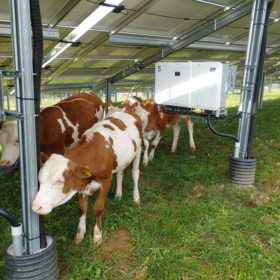
How to protect animals from lightning in agrivoltaics
Researchers in Germany assessed lightning risks in livestock-integrated agrivoltaic systems, identifying key injury mechanisms and establishing safe step and touch voltage limits. Their simulations showed edge strikes and conductive structures pose the highest hazards, highlighting the need for livestock-specific earthing designs and mitigation strategies.
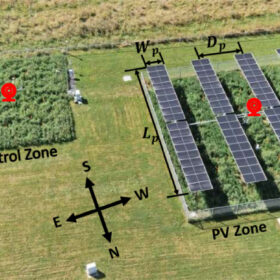
How airflow modifications in agrivoltaics affect crop yield, energy output
New research from France shows that PV panel height critically influences airflow and evapotranspiration in agrivoltaic systems, with panel heights of less than 3 m affecting crops through altered airflow. The scientists highlighted the need for site-specific measurements and computational fluid dynamics to accurately estimate water and energy exchanges beneath PV panels.
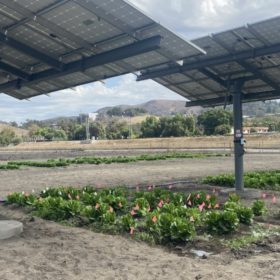
Agrivoltaics for regenerative agriculture
U.S. researchers are testing regenerative agrivoltaics at a farm in Southern California, combining solar panels with soil-restoring practices like composting, cover cropping, and no-till farming to enhance crop yields, soil health, and water-use efficiency. The pilot evaluates technical, ecological, and economic viability while exploring how this land-sharing approach can optimize food and energy production, reduce irrigation needs, and inform larger-scale deployment and policy frameworks.
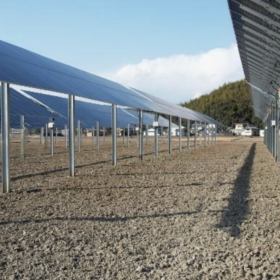
Idemitsu switches on 2 MW of solar above rice paddy
Japanese petroleum company Idemitsu Kosan has announced its 2 MW agricultural solar power plant, installed 3.8 meters above a rice paddy, has begun operating. The project features a community-based model that returns a portion of the profits from power generation to the farmers.
