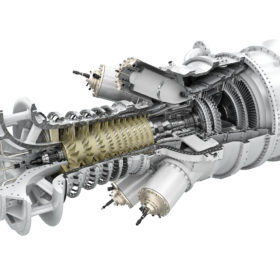
Siemens and Engie plan 12 MW green hydrogen and gas project in France
A €15.2 million power-to-X-to-power hydrogen storage facility is being planned in Saillat-sur-Vienne, in Nouvelle-Aquitaine. The project partners want to use renewable energy from the grid and water to produce and store electrolyzed hydrogen. It would then be mixed with natural gas to power an upgraded, 12 MW Siemens SGT-400 industrial gas turbine which previously generated steam for local manufacturing and would be able to return power to the grid to meet demand.
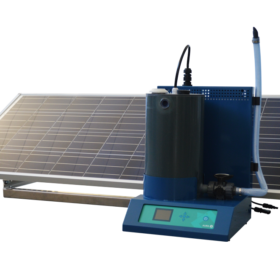
A disinfectant system powered by solar
French PV company Solea has developed a system which can produce 8-16 liters of solar-powered disinfectant solution per day.
Chinese coal miner starts work on world’s biggest solar-powered hydrogen facility
Baofeng Energy appears to be switching its focus to hydrogen production and says its new project will be powered by two 100 MW solar plants and will start producing 160 million cubic meters of hydrogen annually from next year.
Australian researchers enhance clean hydrogen electrolysis
Griffith University scientists have unlocked a catalytic process to enhance the breakdown of water into hydrogen and oxygen and bring Australia a step nearer clean, efficient hydrogen fuel.
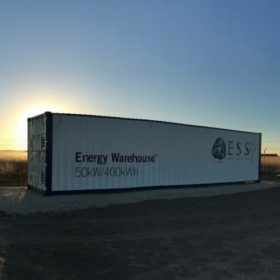
U.S. research teams aim for long-duration storage at $0.05/kWh
To get long-duration storage costs down to $0.05/kWh, research teams funded by ARPA-E are pursuing breakthroughs in flow batteries, hydrogen storage and other technologies – even thermovoltaics.
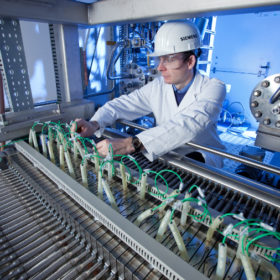
A new catalyst to split hydrogen from seawater
Scientists at the University of Houston in the United States have developed a new catalyst which they say can efficiently produce hydrogen from seawater. The group says that its discovery significantly advances the development of seawater electrolysis for large-scale hydrogen production.
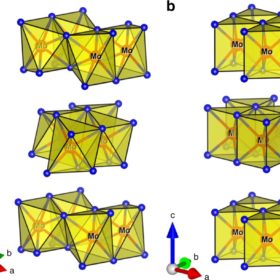
Scientists double down on hydrogen production
A team of scientists led by the University of Glasgow has discovered a more efficient method of splitting water into hydrogen and oxygen using electricity which it says could almost double the amount of hydrogen produced per millivolt.

Operation Silver Frog: Innovative 2 GW solar production plan for green hydrogen in Europe
European partners have submitted a joint proposal to use EU-made solar modules and wind turbines to power green hydrogen for use by heavy industry. The partners hope to secure designated status and backing from the bloc’s deep coffers.
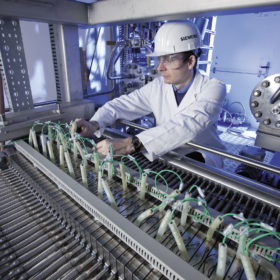
The slow, inexorable rise of green hydrogen
The International Renewable Energy Association says the integration of hydrogen into the energy transition will not happen overnight and electrolysis costs will not be halved until the 2040s. That hydrogen and related products could revolutionize the world energy landscape, however, is not in doubt.
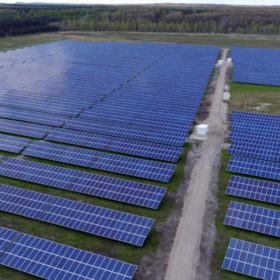
Germany will need 160 GW of solar by 2030 to prevent power shortages
EuPD Research has calculated what needs to be done to replace the nuclear and coal generation to be phased out in Germany. Accelerated expansion of PV appears the best short-term option. However, storage capacity will need to increase 30-fold by 2040 so solar can become the main pillar of the country’s energy system.
