
Solar could be crowned ‘king’ of Latvia’s energy market
Latvia recorded 54 MW of installed solar capacity at the end of last year, according to International Renewable Energy Agency (IRENA) statistics. This is “miserable” compared to the country’s Baltic siblings, one energy expert tells pv magazine. But if Latvia lands the right utility-scale opportunities, solar could be one of its renewable energy stars.
Maxeon sues Aiko Solar for alleged patent infringement
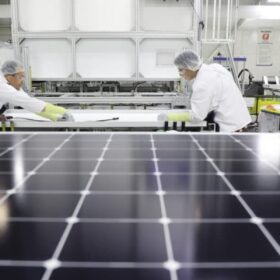
PV manufacturer Maxeon has filed a lawsuit in Germany claiming that its rival, Aiko Solar, has breached European patents for the architecture of back contact solar cells. Aiko Solar has denied the allegations.

Residential PV for urban loads as an antidote to solar curtailment
Researchers in the Netherlands have proposed the use of residential PV capacity to supply electricity to urban loads such as tram substations and dwellings, potentially reducing PV curtailment and demand for additional storage.

Antora Energy receives $4 million grant to scale thermophotovoltaic technology
Antora says its thermal batteries offer a cost-effective way to store energy and produce high-temperature industrial heat and electricity on demand
SAJ releases new battery inverter series for residential applications
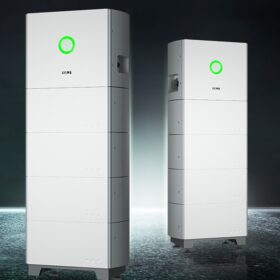
China’s Guangzhou Sanjing Electric (SAJ) has developed two new single-phase and three-phase all-in-one battery inverters with efficiencies of 97.8% and 98.0%, respectively. They use artificial intelligence to support energy management.
Euro’s electricity prices recovered by falling wind generation
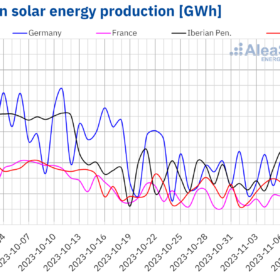
Electricity market prices recovered in the second week of November due to falling wind production. MIBEL recorded the lowest weekly average price for the third consecutive week.
Swiss scientist to develop hybrid flow lithium-ion batteries
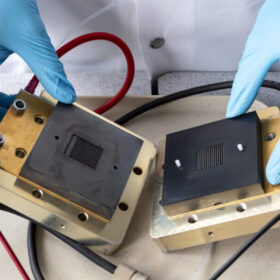
A scientist in Switzerland is trying to develop a hybrid flow battery and lithium-ion battery by incorporating solid storage materials into the flow battery tank. He is currently identifying stable materials for the storage tanks over a 20-year operating period.

South Africa’s largest battery storage project goes online
South Africa’s public utility, Eskom, has switched on a 20 MW/100 MWh Hex battery energy storage system (BESS) in Worcester, Western Cape province, to mitigate the challenge of load shedding.
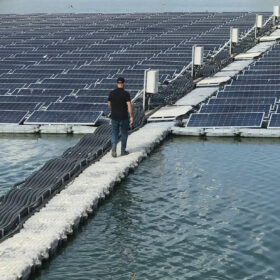
Malaysia launches 30 MW floating solar tender
Kuala Lumpur-based utility Tenaga Nasional Berhad (TNB) has started accepting applications for the development of a 30 MW (AC) floating PV plant at a reservoir in eastern Malaysia.

Saudi Arabia announces 3.7 GW solar tender
Saudi Power Procurement Co. (SPPC) has announced a request for qualification (RFQ) in relation to 3.7 GW of solar across four projects, as part of the fifth round of the Saudi Arabian government’s renewable energy tender program.
