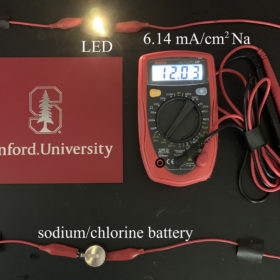
New alkali metal-chlorine battery promises 6x energy density
Scientists in the U.S. discovered a promising new battery chemistry based on chlorine and table salt. Batteries based on this chemistry can achieve at least six times the energy density of today’s lithium-ion batteries, according to the group that created it. The prototype battery could already be suitable for small devices such as hearing aids, and with further work could be scaled up to larger applications.

Novel battery chemistry for zinc-ion batteries
Scientists have demonstrated a zinc-ion battery that overcomes many of the challenges for this technology. By working with a highly-concentrated salt solution as the electrolyte, the group was able to achieve stability over more than 2,000 cycles combined with a strong electric performance. The group says that its work opens up “a viable route to developing aqueous batteries for emerging electrochemical energy storage applications.”

Solar+storage in the Russian Arctic
Hevel Energo Servis has developed a new solar+storage project under Russia’s energy service scheme to help independent power producers to sell power to municipalities with diesel power plants via a competitive bidding scheme.

Cheapest long-duration storage for systems with high renewables
National Renewable Energy Laboratory researchers have studied which tech offers the lowest levelized cost of energy to provide the US Western Interconnection grid with electricity when wind and solar are not available. They assumed 85% renewables penetration and determined that geologic hydrogen storage and natural gas combined-cycle plants with carbon capture storage are the cheapest options for 120-hour discharge applications.

Gravity-based renewable energy storage tower for grid-scale operations
Energy Vault secured $100 million in Series C funding for its EVx tower, which stores gravitational potential energy for grid dispatch.
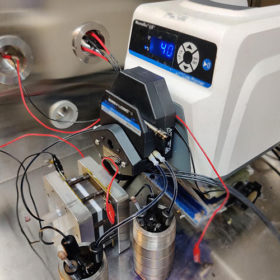
Redox flow battery retains more than 90% of capacity over 6,000 cycles via new catholyte
The battery was built with a new catholyte and a symmetry-breaking strategy, which consists of changing the symmetry of the redox-active organic molecules instead of using the common approach of attaching a hydrophilic functional group.

The weekend read: China’s battery storage awakening
China’s efforts to shift electricity generation from a coal-dominated system to a greener mix of renewables is not only centered on wind, solar and other technologies – the country is also rapidly pursuing energy storage. Vincent Shaw reports from Shanghai.
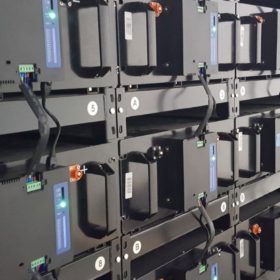
Energy storage appears to be fully charged for exponential growth
Lithium-based energy storage volumes are expected to grow by multiple orders of magnitude in the coming years, with a 1,000% capacity increase by 2023.
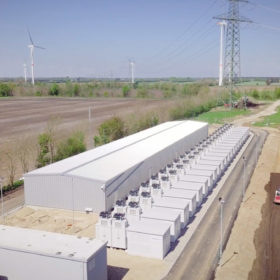
Grid-scale storage potential in India
A new study provides a novel assessment of grid-scale storage deployment in India, both in the near term and the long term. Scenario-based capacity expansion modeling shows when, where and how much storage can be cost-effectively deployed in India through 2050.
Novel salt solution for lithium-ion battery fires
Australian researchers have tested a novel lithium salt for high-voltage lithium batteries in electric vehicles and grid-scale storage systems. They claim the salt is less hazardous than conventional battery materials.
