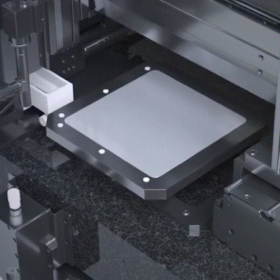
Gosan Tech launching inkjet systems for perovskite solar cells
The South Korean inkjet technology company is expanding to provide inkjet printing systems for perovskite solar photovoltaic manufacturing. An investment by a corporate venture fund backed by Japan’s Epson Group is expected to help it expand the business and widen the applications of its industrial inkjet technology.
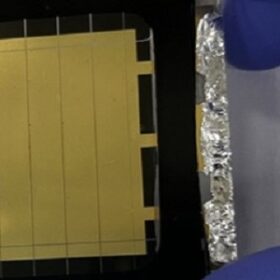
Inverted perovskite solar cell based on ionic salt achieves 26% efficiency
An international team led by the U.S. National Renewable Energy Laboratory (NREL) has used ionic salt for the electron transport layer of a perovskite solar cell to improve device stability and performance. Test results showed a 26% power conversion efficiency with 2% degradation after 2,100 hours of 1-sun operation at 65 C.
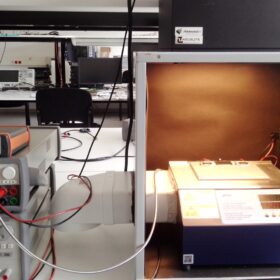
Artificial light tests for indoor PV
Researchers at the Universitat Politècnica de Catalunya in Spain evaluated 12 PV devices from 11 suppliers for indoor use, identifying several systems capable of powering remote sensor nodes with a 10 cm² surface area and advancing to testing under natural indoor light.
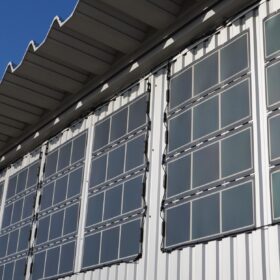
Aisin Corporation starts perovskite solar PV outdoor trial
The Japanese automotive components and systems manufacturer began testing its proprietary organic perovskite solar modules in what will be a 30 kW outdoor field trial at one of its facilities in Anjo.
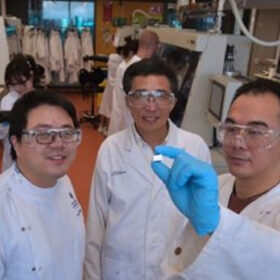
Australian researchers build 2D/3D tin halide perovskite solar cell with 16.65% efficiency
Researchers at the University of Queensland have developed a 2D/3D tin halide perovskite (THP) solar cell with a certified efficiency of 16.65% and peak performance of 17.13%, maintaining stable output under continuous illumination for over 1,500 hours.
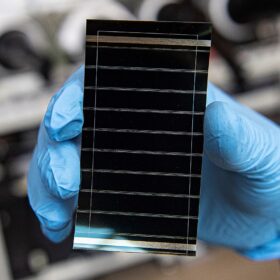
Caelux developing perovskite-silicon tandem solar with four-terminal configuration
While many perovskite developers pursue a 2-terminal format, which poses design and production constraints, Caelux uses a 4-terminal approach that can reportedly help bypass technical challenges.
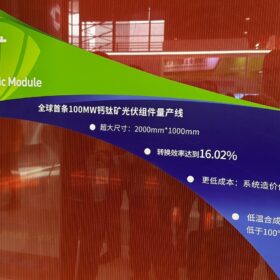
GCL claims 19.04% efficiency for perovskite solar panel
The Chinese manufacturer was able to increase the panel efficiency from 18.04% to 19.04% in 16 months. The panel has a size of 2,005 mm x 1,005 mm x 35 mm and a weight of 34.5 kg.

Agrivoltaics for radicchio
An Italian research team has found that radicchio seedlings grown in a lab-scale greenhouse with a perovskite solar PV roof exhibited faster growth and larger leaves than the bare glass reference. In addition, simulations of such a PV roof revealed a positive energy balance, satisfying the energy demands of a typical greenhouse located in Italy.

Alumina oxide nanoparticles extend perovskite solar cell lifetime
Scientists in the U.K. have used alumina oxide in perovskite solar cells to achieve lifetimes exceeding 1,300 h under standards-based heat and humidity testing. Their analysis showed that a reference cell based on conjugated polyelectrolytes degraded in one-tenth the time.
Dutch consortium seeks to reduce costs of hole transport layers for perovskite solar cells
Two Dutch manufacturers have teamed with TNO’s perovskite solar cell experts to integrate spatial atomic layer deposition equipment to produce ultra-thin, high-quality nickel-oxide hole transport layers in a roll-to-roll process. The team targeting production integration in mid-2027, with full-scale production by 2030.
