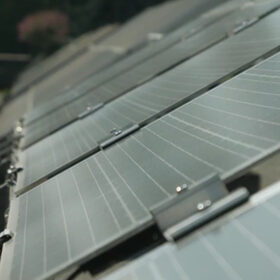
One-year perovskite solar module testing shows promising outdoor stability
Scientists at the European Commission Joint Research Centre tested two single-junction perovskite modules outdoors for one year and reported overall stable performance, supported by a new light-soaking preconditioning method to improve measurement reliability. While one module degraded significantly, the other maintained relatively stable efficiency with seasonal variations, highlighting the need for longer-term outdoor studies.
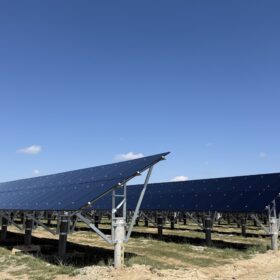
Why AI matters for scaling perovskite solar modules
pv magazine spoke with Fan Bin, founder of GCL Optoelectronics, about how high-throughput experimentation and AI-driven optimization are accelerating perovskite development, and why stability, and not efficiency, remains the key challenge on the path to mass production
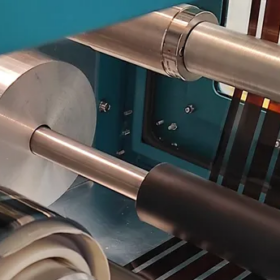
Power Roll testing new metrology for perovskite solar
The UK-based perovskite solar PV specialist has announced a new metrology research project with Swansea University and a new development agreement with Renolit, a German plastic films, sheets and polymer solutions company.

Korean scientists build mini perovskite solar module with 22.56% efficiency
GIST researchers have developed a perovskite mini-module with 22.56% efficiency by improving the SnO₂ electron transport layer with PEI, reducing defects and electron loss. The module retained 94% of its performance after 500 hours, highlighting potential for scalable, stable perovskite solar cells and modules.

Flexible perovskite solar cells with tunable color, transparency
Researchers at Hebrew University of Jerusalem have demonstrated 9.2% efficient printable semi-transparent, flexible halide perovskite solar cells with tunable color and transparency.
Chinese startup claims record-breaking 27.87% efficiency for single-junction perovskite solar cell
Shenzhen-based SolaEon has reported a 27.87% efficiency for a single-junction perovskite solar cell on a 0.076 cm² lab device, certified by China’s National Photovoltaic Industry Metrology and Testing Center.
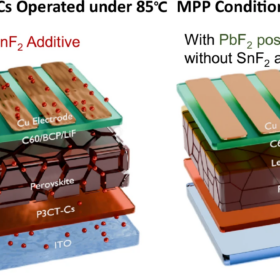
Scientists build tin lead perovskite solar cell with 24.07% efficiency
A Chinese-Swedish research team has boosted the performance of tin-lead perovskite solar cells by modifying additives and post-treatment processes. The device also demonstrated improved stability, retaining 60% of its initial efficiency after 550 hours at 85 °C under maximum power point conditions.

Australian startup moves forward with perovskite solar manufacturing plans
Halocell Energy is set to benefit from the development of a sovereign supply chain for high-purity precursors to perovskite after signing a memorandum of understanding with Queensland advanced materials company Lava Blue.

Scientists achieve 32.6% efficiency in perovskite-silicon tandem solar cell via interface engineering
Researchers from KAUST, TU Delft, and LMU Munich have improved the performance of monolithic perovskite-silicon tandem solar cells by modifying the physical structure at the front of the bottom heterojunction solar cell.

Scientists achieve 25.4% efficiency in perovskite solar cells with enhanced stability using multivalent ligands
Researchers have used multivalent amidinium ligands to boost perovskite solar cell efficiency to 25.4%, achieving over 95% stability after 1,100 hours at 85 C. The proposed approach enables controlled low-dimensional passivation layers, offering a practical route for durable, large-area perovskite devices.
