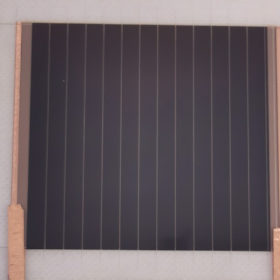
Perovskite solar module achieves 21.07% efficiency via nanosecond laser tech
Chinese researchers have used inverted perovskite cells with a p-i-n structure to build a perovskite solar module with a reduced heat-affected zone. The panel achieved a power conversion efficiency of 21.07% and a geometric fill factor of 95.5%.
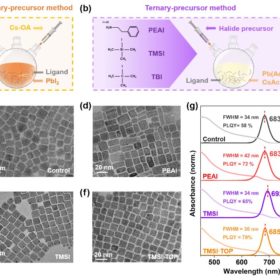
Perovskite quantum dot solar cell with 16.25% efficiency
Chinese researchers have built a perovskite quantum dot solar cell that is reportedly able to reduce trap-assisted charge carrier recombination. The device has an open-circuit voltage of 1.23 V, a short-circuit current density of 17.73 mA cm−2, and a fill factor of 0.745.

New ferroelectric material for lead-free perovskite solar cells
US scientists have discovered a lead-free perovskite material with ferroelectric properties that can be used in solar cells. The perovskite compound was grown from cesium germanium tribromide and initial analysis shows that it produces ferroelectricity.
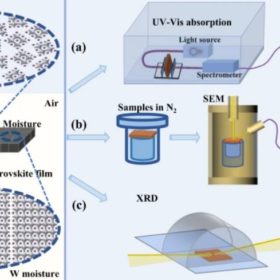
Perovskite solar cell with 23.93% efficiency via new moisture treatment
Scientists from China developed a controllable moisture treatment for perovskite films that is reportedly able to promote the mass transportation of organic salts. The films were used to build a 0.2 cm2 perovskite solar cell that was able to retain 80% of its initial efficiency after 1200 h.
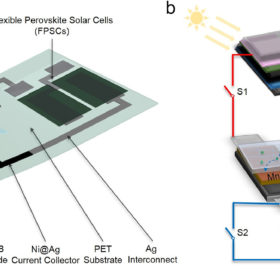
New battery needs seconds of sunlight to keep wearables charged
Researchers at Surrey’s Advanced Technology Institute have demonstrated a new, highly integrated, flexible photo-rechargeable system based on zinc-ion batteries and perovskite solar cells. It only needs a few seconds of sunlight to keep smart wearables charged.
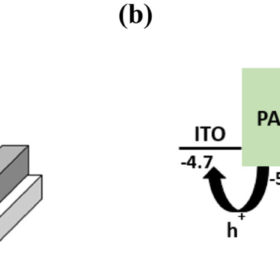
Inverted perovskite solar cell with 16.94% efficiency
A US-Chinese research group has built a perovskite solar cell with a hole-transporting material (HTM) based on conducting polyaniline (PANI) polymer. The device showed significantly higher efficiency than a reference solar cell relying on an HTM made of commonly used PEDOT:PSS.
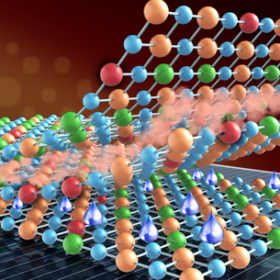
Surface engineering for an 18.6% efficient large-area inverted perovskite solar cell
Scientists in China worked with nickel-oxide as a charge transport layer in a perovskite solar cell, and were able to overcome several of the performance challenges associated with this material through careful surface engineering. Using this approach, the group fabricated an inverted perovskite solar cell measuring 156×156 mm that achieved 18.6% efficiency, along with ‘remarkable’ stability, according to its designers.
Perovskite solar cell defect characterization during manufacture for improved stability
A novel electrochemical robotic arm is under development at the University of Arizona to identify perovskite defects during manufacturing rather than after to improve durability.
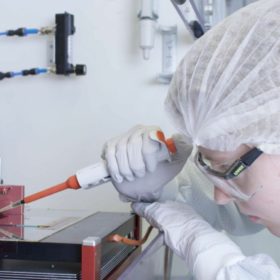
Eco-friendly solvent for a 16.7% perovskite solar cell
Scientists in Germany looked to eliminate the use of toxic solvents in the production of perovskite solar cells, replacing them with a more environmentally material called dimethyl sulfoxide (DMSO) which has so far proved difficult to integrate into processes suitable for large-scale production. The group demonstrated a scalable blade coating process using DMSO as the only solvent, and reached cell efficiencies close to those achieved using more toxic substances.
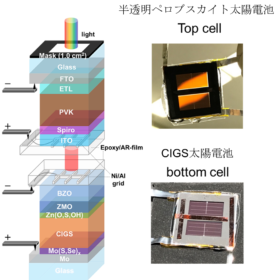
Four-terminal tandem perovskite/CIGS solar cell with 26.2% efficiency
Japanese scientists have developed a tandem device with a 19.5%-efficient perovskite top cell. They claim to have created a semi-transparent perovskite solar cell while maintaining high performance.
