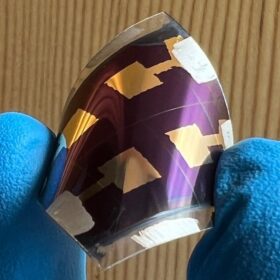
Flexible indoor perovskite solar cell achieves 32.5% efficiency
Italian scientists have developed a flexible indoor perovskite solar cell with 32.5% efficiency. Their design uses a PET substrate combined with a tetrabutylammonium bromide layer over the perovskite absorber. This additional layer effectively reduces defect density and enhances the stability of the underlying 3D perovskite structure.
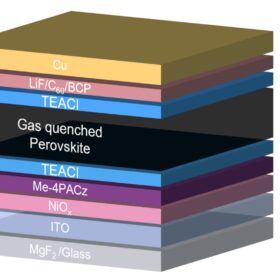
Imec presents inverted perovskite solar cell with 24.3% efficiency
The researchers of the Belgian research institute used a dual-layer treatment for the perovskite absorber, which they said improved the cell efficiency and stability. The device achieved an open-circuit voltage of 1.17 V, short-circuit density of 24.5 mA/cm2, and a fill factor of 84.6%.
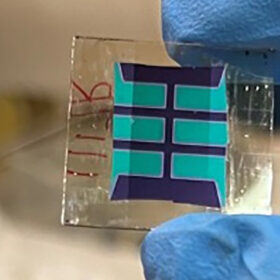
NREL develops perovskite solar cells with 93% bifaciality
The National Renewable Energy Laboratory (NREL) has made highly bifacial perovskite cells with a front-side efficiency of 23%.
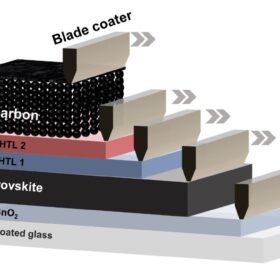
Fully printed carbon electrode perovskite solar cell achieves 19.2% efficiency
German scientists have fabricated a carbon electrode perovskite solar cell with a hole-transporting bilayer made of organic semiconductors instead of a conventional hole transport layer. They claim this approach improves the device’s fill factor and open-circuit voltage.
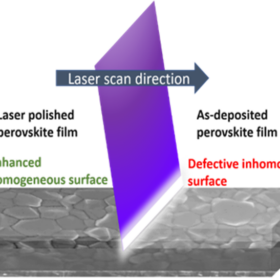
Commercial laser treatment to boost perovskite solar cell performance
European scientists used a nanosecond pulsed ultraviolet laser to reduce surface defects in perovskite films for solar cell applications. The result is a significant increase in cell efficiency and stability. The new technique may be particularly suitable for roll-to-roll (R2R) production lines.
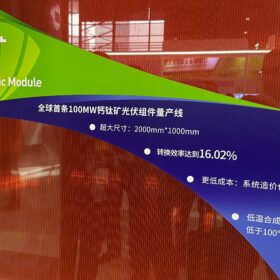
GCL-SI unveils perovskite solar panel with 16.02% efficiency
GCL-SI has launched a new 320 W perovskite solar module. The company guarantees that the 10-year end power output will be at least 90% of the nominal output power, which decreases to 80% after 25 years.
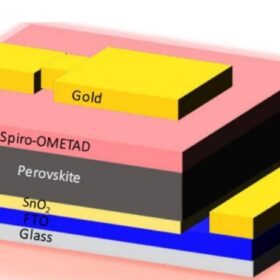
Triple cation perovskite PV cell with ETL based on tin(IV) oxide hits 17.1% efficiency
Qatari researchers have incorporated an electron transport layer (ETL) made of tin(IV) oxide into a perovskite solar cell through air-thermal-annealing, resulting in better efficiency and stability. The device demonstrated an open-circuit voltage of 1.045 V, a short-circuit current of 22.01 mA/cm2, and a fill factor of 74.3%.
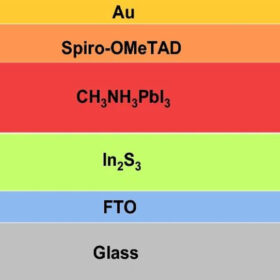
Perovskite solar cell based on indium sulfide ETL promises 20.15% efficiency
An international team has sought to use indium sulfide as an electron transport material in a perovskite solar cell. The result is a device with lower defect density and improved performance.

Longi claims 33.5% efficiency for perovskite/silicon tandem solar cell
The European Solar Test Installation (ESTI) has confirmed the results of Longi’s new perovskite/silicon tandem solar cell. It is currently the second-highest efficiency record in the world for a perovskite/silicon tandem cell.
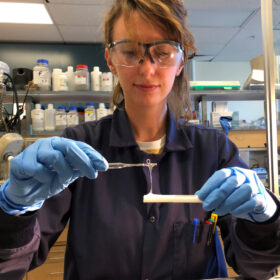
Treatment promises 1000-hour stability for solar perovskites
Scientists in China and Canada have developed an additive that forms covalent bonds with the organic materials in a perovskite solar cell, leading to fewer defects and greatly reduced degradation. Cells treated with the additive maintained 98.6% of their initial performance after 1,000 hours in testing. Xlynx Materials, a company spun out of the University of Victoria in Canada, is making the material available for further commercial trials.
