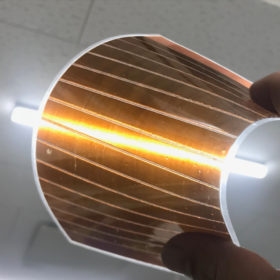
Japan aims to deploy 20 GW of perovskite solar by 2040
The Japanese government says it expects perovskite solar modules to be produced in large quantities at JPY 20 ($0.13)/W by 2025, JPY 14/W by 2030, and JPY 10/W by 2040.
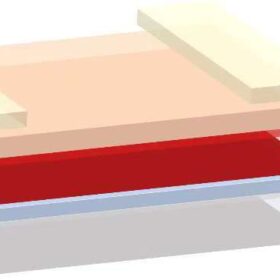
Ultrathin perovskite solar cell based on Gires-Tournois resonator
Scientists in China have conceived a perovskite solar cell that uses a back mirror based on silver to improve light harvesting. The device could reportedly achieved a power conversion efficiency of over 27%.
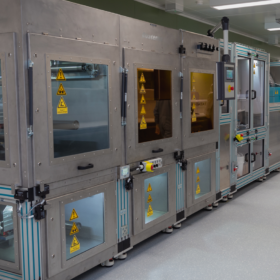
Coatema launches roll-to-roll production lines for organic, perovskite, dye-sensitized solar cells
German PV equipment company Coatema Coating Machinery says its roll-to-roll processing solutions cover from lab or pilot to production scale.
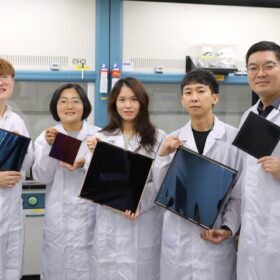
KRICT sets world record with 20.6% efficiency for large-area perovskite cells
The Korea Research Institute of Chemical Technology (KRICT) has set a world record for power conversion efficiency at 20.6% for large-area perovskite solar cells exceeding 200 cm². The result, confirmed by Germany’s Fraunhofer Institute for Solar Energy Systems ISE (Fraunhofer ISE), marks a significant milestone in solar cell technology.

UtmoLight unveils 450 W perovskite solar module with 16.1% efficiency
Chinese manufacturer UtmoLight has developed a 450 W perovskite solar module with a 16.1% efficiency rating. It claims that the panel is currently the largest perovskite PV module available.
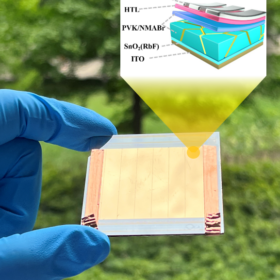
Perovskite solar cell based on lead iodide treated with 4-fluorobenzylamine achieves 23.62% efficiency
By regulating the secondary growth of lead iodide, an international group of scientists has built a perovskite solar cell with low non-radiative recombination and defect state density. The device reportedly exhibited superior stability in both humidity and thermal stability tests compared to reference cells.
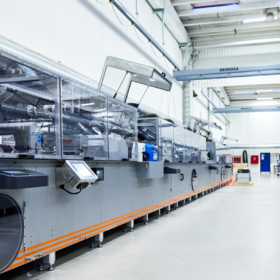
Danish print finishing equipment provider offers turnkey pilot lines for perovskite, organic solar cells
Denmark-based Grafisk Maskinfabrik (GM) is now selling roll-to-roll turnkey pilot production lines featuring slot-die coating, available through its GM Functionals unit.

European team targets 20%-efficient perovskite modules using industrial processes
The LUMINOSITY project consortium aims to develop 20%-efficient metal halide perovskite prototype modules measuring over 900 cm², designed for a 20-year lifespan and compatibility with roll-to-roll (R2R) processing.
Perovskite solar cell built with slot die coating achieves 19.17% efficiency
A team from Jeonbuk National University in South Korea used slot die coating (SDC) to produce uniform high-quality perovskite films, which they used in a perovskite solar cell that achieved 19.17% efficiency and lab cell-sized modules that achieved 17.42% efficiency.
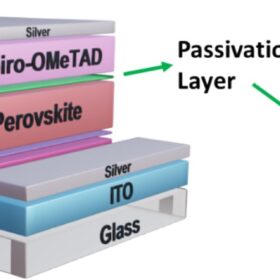
New passivation strategy increases efficiency of chloride-iodide-based perovskite solar cells by 15%
Although local defects in chloride-iodide-based perovskite are hard to avoid due to ion migration, a group of scientists have now found a way to passivate them. They used different combinations of 4-chlorobenzylammonium chloride and 4-chlorobenzylammonium bromide beneath the hole transport layer and reached up to 15% improvement in efficiency.
