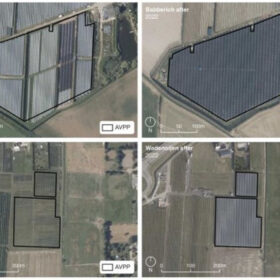
Landscape change indicators for agrivoltaics
Dutch scientists have developed new landscape change indicators (LCIs) for agrivoltaic projects. The novel methodology is meant to assist policymakers and project developers mitigate the visual and environmental impact of agrivoltaic facilities.
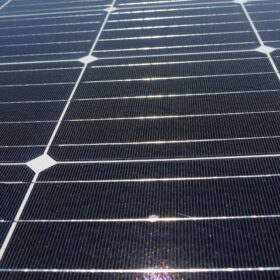
AmpIn Solar begins working on 1.3 GW solar factory in India
AmpIn Solar, a joint venture between AmpIn Energy Transition and Jupiter International Ltd, is building a new 1.3 GW solar cell and module factory in India under the government’s production-linked incentive (PLI) scheme.
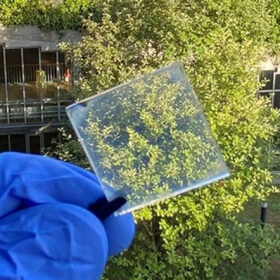
Single-junction transparent perovskite solar cell achieves record-breaking voltage of 1.78 V
A research team in Germany claims to have achieved the highest open-circuit voltage ever recorded to date for a perovskite solar cell based on hybrid methylamine lead chloride (MAPbCl3). The novel perovskite absorber was fabricated with a two-step deposition method and annealing under molecular nitrogen (N2) gas inside a glovebox.
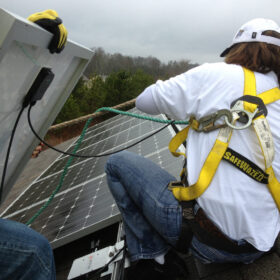
Massachusetts expands solar net metering, bucking a national trend
Massachusetts expanded access to net metering, showing a commitment to distributed energy. The Department of Public Utilities expects to save ratepayers $10 million with the regulatory change.

Chinese PV Industry Brief: Daqo reports revenue drop due to lower selling prices
Daqo increased polysilicon production volume in 2023 to 197,831 MT, representing a 47.8% year-over-year increase compared to 133,812 MT produced in 2022.

Alberta lifts moratorium on renewable energy projects
The government of the Canadian province of Alberta has announced plans to ban new renewables projects on high-quality agricultural land and within a 35 km radius of areas with pristine views, following a nearly seven-month pause on approvals for such installations.

Italian startup offers roll-to-roll process for organic solar panels
Ribes Tech, a spinoff of the Italian Institute of Technology, has established a roll-to-roll process to produce organic photovoltaic modules that it says can be expanded to enable volume production of PV modules for indoor sensors, trackers, and electronic devices.
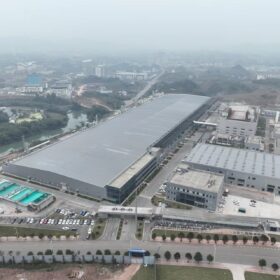
Sunova Solar announces 9 GW cell factory in China
Sunova Solar’s new cell manufacturing facility produces 182 mm, 199 mm and 210 mm TOPCon cells. At full capacity, the facility is expected to produce approximately 36,000 high-efficiency modules per day.
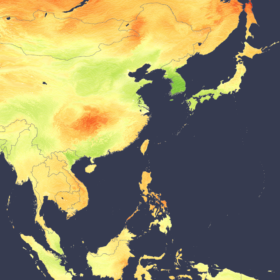
Solar producers across Northern Asia miss out on El Nino generation bump
In a new weekly update for pv magazine, Solcast, a DNV company, reports that solar producers in several provinces of Central China benefited from clearer than normal conditions in December and particularly February, bringing up the average to 20% more than expected. Furthermore, Solcast analysis reveals that, during the same period, Korea and Southern Japan saw consistently cloudier conditions than in normal years, decreasing irradiance and solar potential across the region.
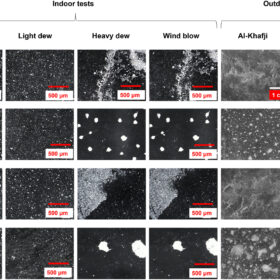
Scientists describe anti-soiling performance mechanisms in solar glass
Laboratory and outdoor soiling experiments conducted in Saudi Arabia have shown that increased particle resuspension by wind is one of the dominant factors for high anti-soiling performance in photovoltaic glass.
